WeedLife News Network

Hot off the press cannabis, marijuana, cbd and hemp news from around the world on the WeedLife Social Network.

Lawmakers Call for Cannabis and Police Reform

Policing reform may have passed the House on a mostly party-line vote, but the battle isn’t over, especially for pro-cannabis lawmakers who argue the failed ‘war on drugs’ has fueled racial tension in low-income communities across the nation for decades now.

After being rebuffed by congressional leaders who asked that amendments on cannabis not be offered in the midst of the historic policing reform debate at the Capitol, pro-cannabis lawmakers are vowing to redouble their efforts to get federal decriminalization (if not outright legalization, which remains their ultimate goal) passed by the end of this year.

“I’m going to keep pounding on this issue, because it is the right thing to do,” Rep. Lou Correa (D-Calif.) told Wikileaf at the Capitol.

While Correa raised his marijuana decriminalization amendment in the House Judiciary Committee, he ultimately pulled it after party leaders asked that the legislation stay focused merely on items like banning chokeholds and ending qualified immunity (political-speak for allowing officers to do basically whatever they want without fear of punishment).

But with cannabis and drug arrests of minorities across the US drawing condemnation from international bodies (namely, the United Nations), a growing number of officials and advocates are demanding that overhauling drug laws be a part of any policing reform in the future.

The House-passed police overhaul did include one component that could be a game-changer: Ending no-knock drug warrants. After Breonna Taylor was allegedly murdered by Kentucky police, cannabis advocates in Congress made sure the issue took center stage in the policing reform debate, even if they recognize it’s merely a first step in the long march ahead.

Still, drawing national media attention to the practice of no-knock warrants – along with actually passing the legislation out of the House – is seen as a win. In part because even most lawmakers can’t comprehend the practice.

e-mail icon
Continue reading

Will The Hemp Industry Revive New York's Economy?

Nestled near the confluence of the Susquehanna and Chenango rivers in Upstate New York, the city of Binghamton and the surrounding county, Broome, was always a hotbed of agriculture and manufacturing. From the rivers to railroads to highways, the area has been at the hub of transportation networks and grew steadily through the 20th century.

Part of New York’s Southern Tier region along the Pennsylvania border, it was the home of the Endicott Johnson Shoe CompanyIBM and later, the flight simulator, which was invented and continued to be manufactured in Binghamton. The area boomed through the Cold War era, in part because of its defense-heavy industries, earning it the nickname “The Valley of Opportunity.”

But after the fall of the Soviet Union in the late 1980s, things began to change and both the city and the region experienced a decline in population and money. The shoe factory once employed more than 15,000, but declined and finally closed in 1998. IBM saw its workforce drop from more than 16,000 in the 1980s to a few hundred before it finally sold the plants in 2002.

“You really saw in the late-’80s and through the mid-’90s the manufacturing sector kind of hollowed out,” says current Broome County Executive Jason Garner.

“We’re a manufacturing community that lost its manufacturing base, not unlike Rochester which lost Kodak, or other places that lost major anchors,” agrees Assemblywoman Donna Lupardo, who represents the area in the New York Legislature. “We were the home of IBM and the Endicott Johnson Shoes that collectively employed (thousands of) people that are no longer employed.”


Continue reading

From criminal justice reform to a new Cannabis Compliance Board, new laws take effect in Nevada on July 1

Laws implementing a wide range of criminal justice reforms, establishing a state board responsible for regulating marijuana and creating a payday loan database finally take effect Wednesday, more than a year after the 2019 legislative session ended.

Another bill, which will raise the minimum wage to $12 by 2024, technically took effect on July 1, 2019, though the first wage increase kicks in on Wednesday.

Other bills that take effect Wednesday aim to reduce workplace violence in hospitals and psychiatric hospitals, establish new provisions regarding the regulation and labeling of hemp products and raise the GPA requirement for the Millennium Scholarship.

AB533: Cannabis Compliance Board

This new law transfers most of the responsibilities of marijuana regulation starting Wednesday to a new, five-person Cannabis Compliance Board, modeled off of the Gaming Control Board. The board will now be responsible for the law enforcement, regulation and compliance duties that previously fell under the Department of Taxation. 

e-mail icon
Continue reading

Majority of Kiwis will vote in favour of cannabis legalization, new poll finds

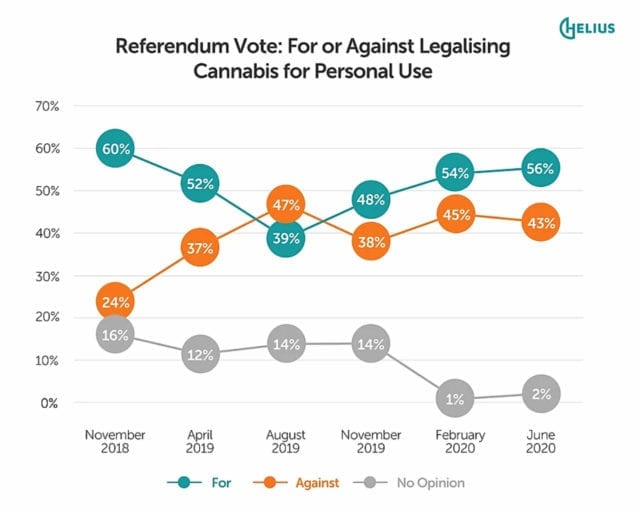
With a national referendum just three months away, a new poll has found a growing majority of New Zealand voters are in favour of legalizing cannabis for adults.

In May, the New Zealand government revealed the final draft of a cannabis reform bill that included a framework for a regulated adult-use market.

Kiwis will have the option to vote yes or no on the cannabis legislation in a referendum as part of the Sept. 17 national election. Although the referendum is non-binding, the country’s current coalition government has pledged to enact the bill should the referendum be successful and they remain in power.

If the law passes it would not alter New Zealand’s medical cannabis regulations that came into effect April 1.

The new poll found 56 per cent of respondents plan to vote in favour of legal weed, up from 54 per cent in February. The independent survey of nearly 1,600 Kiwis was conducted in June by Horizon Research and commissioned by licensed medical cannabis company Helius Therapeutics.

Majority of Kiwis will vote in favour of cannabis legalization, new poll finds
Continue reading

Amid Government Corruption, Macedonia Waits on Legislative ‘Go-Ahead’ to Export Cannabis Flowers

For more than 14 years, the tiny, poor Balkan country of North Macedonia has been trying to edge its way into the EU. Now, with just over two million inhabitants, and legislation to run a global medical cannabis market, North Macedonia is fighting corruption to prove that big things can come in very small packages.

In Macedonia, cannabis is illegal for recreational use. There are no personal use or decriminalization laws. It cannot be bought, sold, grown, or used legally by private residents for recreational purposes. Prison sentences for being caught breaking cannabis laws can go up to 10 years.

Medical cannabis in North Macedonia

In 2016, a North Macedonian Health Committee approved an amendment to the laws governing the control of psychotropic substances, allowing for cannabis to be used legally for medicinal purposes. Both ruling and opposition parties were in favor of the change. Part of the reasoning behind the necessity of the law, was to make it so that people who were already using such products illegally to self-medicate, could get better results with medical supervision.

The new laws allowed oils and extracts with .2% THC or lower to be sold without a prescription, and those containing greater than that amount to require a prescription. According to the law, the only doctors capable of writing prescriptions for cannabis products are: radiologists, oncologists, neurologists, and infectious disease specialists.

To give an idea where North Macedonians themselves stood on the issue of legalizing for medicinal use before it happened, a poll from the previous year published by the M-Prosepekt agency, found that 70% of those polled were for the legalization. This number was up 20% from a similar poll done in 2013.

Medical cannabis production in North Macedonia

Along with opening up the laws to allow for residents to have access to medical marijuana, North Macedonia also opened up its laws for the cultivation, production, and exportation of cannabis products.

e-mail icon
Continue reading

FDA Issues Guidance On Prescription Drug Marketing Act

In response to the COVID-19 emergency, the FDA is announcing a temporary policy regarding enforcement of the requirement for drug samples.

The U.S. Food and Drug Administration (FDA) is issuing updated guidance to address questions they’ve received asking for clarification regarding their enforcement of requirements on the distribution of drug samples under the Prescription Drug Marketing Act (PDMA) of 1987 . The PDMA is part of the Federal Food, Drug, and Cosmetic Act, and the relevant implementing regulations regarding drug samples are in 21 CFR part 203 (part 203), subpart D.

The relevance of this modification affects health care providers, patients affected by COVID-19 and related conditions, and the life science companies themselves, according to information highlighted in The National Law Review

The drug sample revisions, issued by the FDA earlier in June, affect how licensed practitioners provide care and consultation to their clients during a public health emergency. In response to the COVID-19 emergency, the FDA is announcing a temporary policy regarding enforcement of the requirement for drug samples. This policy covers samples only to be sent to the requesting healthcare practitioner licensed to prescribe the drug, or to a professional at the pharmacy of a hospital or health care entity.

Under the current FDA guidance during the public health emergency (PHE), the FDA clarified drug samples can not be distributed to licensed retail pharmacies. That set of regulations has effectively not changed.  

How Marijuana Helped Me Overcome My Addiction To Pain Pills
Continue reading

Southern California counties clear 100,000 cannabis convictions by July 1 deadline

As calls for criminal justice reform sweep the nation, California is taking steps to reverse some effects of the war on drugs, which continues to disproportionately impact people of color.

California’s 58 county district attorneys had a deadline of Wednesday, July 1, to accept or challenge the state’s recommendation to clear the records of some 191,090 past marijuana convictions. The procedure was triggered by Proposition 64, a 2016 measure that legalized cannabis and reduced penalties for related crimes, and by Assembly Bill 1793, which requires justice officials to purge eligible crimes from people’s records.

Because local prosecutors agreed with the vast majority of the state’s recommendations, tens of thousands of Californians are now free of criminal records for cannabis charges. In many cases, the charges for the cases in question are no longer crimes, but the criminal records still could have meant lost job or housing opportunities or, for immigrants, led to their deportation.

“I think there’s been recognition by a lot of people that we needed to change things,” said Christopher Gardner, public defender for San Bernardino County.

Southern California DAs alone moved to dismiss or downgrade more than 100,000 marijuana charges as the July 1 deadline approached. In some cases, they found even more eligible cases than those flagged by the state. Riverside County, for example, recently adjusted 26,424 cannabis convictions — nearly four times more than the number identified by California Attorney General Xavier Becerra.

e-mail icon
Continue reading

Irish Health Minister Stephen Donnelly smoked cannabis in the past and is open to legalisation

Health Minister Stephen Donnelly says he stands by a 2017 interview in which he admitted to smoking cannabis and visiting a strip club.

The Fianna Fail TD told Hot Press magazine he had tried marijuana – and was open to the idea of making it legal.

Minister Donnelly, 44, also hinted at experimenting with other substances during a Q&A interview given after he left the Social Democrats before joining Fianna Fail.

When asked if he’d ever tried any other drugs Minister Donnelly replied: “I have many years ago. I have but that’s all the detail I’m going to go into.”

Pressed for an answer as to whether he had ever taken cocaine, he said: “I’m just not going to go down any of those lines if that’s OK.”


Continue reading

Hawaii: Hemp production bill advances, but fate uncertain

A bill that would fully legalize hemp production throughout Hawaii is only a few steps away from becoming law, although many are unhappy with its final form.

A joint meeting of the state Senate Judiciary and Ways and Means committees approved House Bill 1819, which would end the state’s current Industrial Hemp Pilot Program and replace it with a general purpose hemp production program designed by the U.S. Department of Agriculture.

Hemp was decriminalized nationwide by the USDA in 2018, but the state has not legalized its production beyond the Industrial Hemp Pilot Program, which has awarded licenses to growers throughout the state for the past two years. Of the 59 licenses awarded, 18 have been to growers on the Big Island.

However, Rep. Richard Creagan of Kailua-Kona, who co-introduced the bill and a similar measure in 2019, said the current state of the bill attracted criticism from hemp advocates who fear certain aspects of the measure will stifle production.

In particular, Creagan said, many testifiers took issue with a provision in the bill that sets mandatory buffer zones around any hemp production facility. Under the bill, hemp cannot be grown within 750 feet of property comprising a playground, child care facility or school nor within 250 feet of any existing residence not owned by the grower.

e-mail icon
Continue reading

Cities in Illinois Can Now Collect More Taxes On Marijuana Purchases

Municipalities in Illinois that have cannabis dispensaries will start seeing more money from recreational marijuana purchases. 

Cities, counties and villages that passed an individual 3% cannabis tax could start collecting it as of July 1. In the Metro East, that means more revenue for St. Clair County, Collinsville and Sauget, areas that passed a tax levy and where the region’s two current dispensaries operate.

Madison County won't collect an additional tax because county board members voted against allowing cannabis sales in unincorporated parts of the county last year.

While the tax increase will likely only be a few extra dollars per purchase, it represents more money for local city and county budgets at a time when some municipalities in the region have laid off workers or considered doing so because of the economic damage caused by the coronavirus.

So far, Collinsville has avoided layoffs by using the taxes it collects from cannabis sales to offset drops in other revenue sources, like sales tax, said City Manager Mitch Bair.

e-mail icon
Continue reading

Australia: NT Farmers Association Promoting Hemp Cultivation

In Australia, the NT Farmers Association (NTFA) is encouraging agricultural producers in the Territory to take a crack at growing industrial hemp now that it is legal to do so with a licence.

The Northern Territory Government planted its first crop of industrial hemp in 2016, but it wasn’t until May 2019 that the Territory’s Hemp Industry Bill was tabled. The bill passed in August last year and the Hemp Industry Act and accompanying regulations came into effect in early May.

Now things are good to go, NT Farmers Association, the peak body for all plant-based industries in the Northern Territory, has been keen to promote the crop as an option for the Northern Territory’s farmers. It recently became a founding member of the Australia Hemp Council and has been working with researchers and industry to develop the NT’s competitive advantage.

One of the advantages the Territory has is the potential for two crops a year –  one potentially producing viable seed via a dry season (May–October) crop, and supplying that to other hemp farmers across Australia for summer planting.

“Hemp is an innovative new broadacre cropping opportunity which produces a versatile, environmentally sustainable and profitable products,” said the Association in a recent Facebook post. “NTFA are keen to work with interested producers to make this new opportunity a reality, so if you are keen to find out more or get in touch, email Andrew on kido@ntfarmers.org.au.”

e-mail icon
Continue reading

Enormous Tax Revenue Is Exactly Why The Feds Won’t Legalize Cannabis

A tax code provision means the federal government profits more from state-by-state legalization than any nationwide model.

Marijuana legalization has been touted as a possible solution to the American economy, which has faced an uphill battle toward recovery following the coronavirus pandemic.  While legalizing marijuana won’t fix every financial woe, the added tax revenue generated through legal cannabis sales and licensing could provide a helpful boost.

In states where cannabis is illegal for adult-use, lawmakers have already pushed cannabis reform legislation with this mindset. Gov. Michelle Lujan Grisham expressed regret in April that New Mexico had not legalized recreational cannabis before the pandemic. Her reason? The state would have an additional $100 million in its budget and recent projections show New Mexico will have a $100 million budget deficit in the upcoming fiscal year.

Bipartisan legislators in New York and Pennsylvania have taken similar stances, seeing legal cannabis as a quick salve to economic wounds.

“It’s not enough to say the state doesn’t have money. We have to find it,” said New York state Sen. Jessica Ramos. “I believe legalizing marijuana can help.”

How Impeachment Could Affect Marijuana Legalization
Continue reading

Will Joe Biden Change His Position On Legalizing Cannabis?

Marijuana legalization is intrinsically tied to social justice.

However, Democratic presidential nominee Joe Biden has maintained his opposition to making cannabis legal. Some hope that could change as more people become aware of the impact that the War on Drugs has had on people of color.

Even as he enjoys an early lead in election polls, people within his own party hope Biden will change his stance. That includes people working on his campaign who have made their support of cannabis legalization public. But any cannabis entrepreneur or investor considering the odds of Biden changing his mind need to look at the full picture of political realities.

First and foremost is the primary vote itself. Despite the fact his opponents took much more progressive stances on marijuana, Biden won.

As Vox noted: “The issue, apparently, wasn’t a major priority for Democratic voters during the primary. Biden still walked away with the most delegates to become the presumptive nominee. With a coronavirus pandemic and recession still underway, perhaps Biden is hoping the same will hold up in the general election, too.”

e-mail icon
Continue reading

Thousands of marijuana offenders in Colorado eligible for rapid pardons under new bill

Thousands of people in the state of Colorado with minor marijuana convictions could be pardoned at once in 90 days after Governor Jared Polis signed into law a new bill on Monday.

Under a broader cannabis social equity bill that state lawmakers passed earlier this month, the governor was also granted the authority to unilaterally mass-pardon Coloradans with minor marijuana possession convictions instead of pardoning individuals on a case-by-case basis. 

“There are too many people that have a prior conviction for personal amounts of cannabis fully legal today that prevent them from getting loans, from getting leases, from raising capital, from getting licenses, from getting jobs, from getting mortgages, and that’s wrong,” Polis said at the signing ceremony, which unfolded at Simply Pure, a black-owned dispensary in Denver. 

Polis added that he hopes the measure will be a “first step” for the thousands of Coloradans who lived “with a cloud over their head” for possessing marijuana, which has been legal in the state since 2012. 

“This bill will give me the ability to offer those convicted of possession of up to two ounces of marijuana – it’s the same amount permitted to medical patients in Colorado today – a pardon that will begin in 90 days pursuant to the signature clause,” Polis said. 

e-mail icon
Continue reading

The Deep South’s Gradual Evolution on Cannabis

Marijuana often demonstrates the ability to win over even the most conservative of individuals. That said, winning over the hearts and minds of America’s vast regions isn’t complete until cannabis endears itself to the nation’s most conservative citizens and lawmakers in the southeast. 

Recent activity indicates that it may just be happening.

Commonly known as the Deep South, the region is the Bible Belt’s shiny, conservative buckle. It’s where conservative viewpoints almost always win out. There, progressive agendas like cannabis reform often face an uphill battle that rivals that of Sisyphus. 

The states that make up the region—Louisiana, Mississippi, Alabama, Georgia, and South Carolina—are home to some of the most self-identified conservatives in the nation. A 2014 Pew political poll found Alabama and Louisiana identifying as the most politically conservative in the country. All of the Deep South finds itself in the upper portion of self-identifying as religious states as well, according to Pew. This includes Alabama, Louisiana, and Mississippi identifying at 86%, 84% and 83% Christian respectively. 

Reform, State By State

Shifting sentiments are underway in areas. The region has made marijuana reform, but not without its hurdles. In Louisiana, its long-anticipated medical market opened in August 2019 after being signed into law in 2015. Despite being slow to open, the medical market could be the first significant legislative domino to fall across the Deep South. 

e-mail icon
Continue reading

Nearly Five Tons of Pot Seized At Canadian Border

Customs officials seized nearly five tons of cannabis last week from a truck that was attempting to cross into the U.S. at the Peace Bridge Port of Entry on New York’s border with Canada, federal law enforcement officers announced on Monday. The seizure is the third large pot bust this month at the border crossing that has seen an uptick in smuggling via commercial vehicles since travel restrictions called in response to the COVID-19 pandemic were put in place this spring.

Assistant U.S. Attorney Misha A. Coulson said in a press release from the Department of Justice that the truck attempted to enter the United States not long before midnight on June 25. The commercial truck with Ontario license plates was carrying a load of 55 storage containers, according to an electronic manifest for the cargo.

When Customs and Border Protection (CBP) officers conducted an x-ray scan of the truck, it revealed inconsistencies with the cargo in the trailer. The vehicle was then directed to a CBP warehouse loading dock for further examination of the shipment. During a physical inspection of the truck, officers “recovered multiple packages of vacuum sealed bags containing a green leafy substance, which field tested positive for the presence of marijuana.”

Truck Driver Faces Life In Prison

Customs officers recovered approximately 8,320 sealed bags from the shipping containers in the truck. A total of 9,472 pounds of marijuana, which officials valued at approximately $20 million, was confiscated by customs officers. The driver of the truck, a 26-year-old Indian national, has been charged with possessing 1,000 kilograms or more of marijuana and importation of marijuana into the United States with the intent to distribute. The charges carry a mandatory minimum penalty of 10 years in prison and a maximum of life behind bars. The defendant has been arraigned before a federal magistrate and is being held pending a detention hearing scheduled for Wednesday.

Port Director Jennifer De La O praised the seizure, characterizing it as “an excellent job by our officers from start to finish.”

e-mail icon
Continue reading

Reforming cannabis laws is a complex challenge, but New Zealand’s history of drug reform holds important lessons

In less than three months, New Zealanders will vote in the world’s first national referendum on a comprehensive proposal to legalise the recreational use of cannabis.

Unlike cannabis ballots in several US states in which the public only voted on the general proposition of whether cannabis should be legalised or not, New Zealanders have access to the detailed Cannabis Legalisation and Control Bill. It outlines how the government proposes to establish a “controlled and tightly regulated” legal cannabis market.

The approach is not like the Brexit referendum, which had no detailed plan of action for a yes vote. Neither is it like New Zealand’s much maligned 2016 flag referendum, in which people knew exactly what they were voting for. In this case, New Zealanders are voting on a proposed law reform, but even following a yes vote, the cannabis regime will have to go through select committees and public consultation. And a legal cannabis market will require monitoring and enforcement.

Referenda campaigners say Covid-19 disrupted plans
In 100 days time, New Zealanders will wake up on a Saturday and be asked to choose the next government, whether to legalise cannabis and also whether to allow assisted dying.
 

The cannabis legislation bill sets out how the government would control and regulate a legal cannabis market, including the following measures:

licensing of cannabis industry operators

The Conversation
Continue reading

Medical cannabis policy and practice in Germany

Dr Franjo Grotenhermen tells MCN about medical cannabis policy and practice in Germany.

Doctor, author and cannabis advocate Dr Franjo Grotenhermen is founder and Executive Director of the International Association for Cannabinoid Medicines (IACM) founder and co-chair of the German Association for Cannabis as Medicine (ACM); and chairman of the Medical Cannabis Declaration (MCD), a charity dedicated to promoting safe access to medical cannabis and evidence-based clinical practice. He tells MCN about the current cannabis landscape in Germany, taking a look at both policy and practice.

What sets Germany’s legislative approach to medical cannabis apart from other EU countries?

Since 2017, under German law every doctor is permitted to prescribe cannabis-based drugs, including cannabis flowers, extracts and individual cannabinoids. Under certain conditions, health insurance companies must cover the costs of therapy. According to the law, health insurance companies may only be allowed to refuse a request for reimbursement in exceptional cases.

What are the main challenges currently facing patients hoping to access cannabis in Germany?

Cannabis and cannabinoids are comparatively expensive in Germany: on average, cannabis flowers cost about €23 per gram. Since health insurance companies very often refuse to cover the costs, many patients cannot afford the appropriate therapy and are forced continue to receive care illicitly even though their doctor supports cannabis-based therapy in principle. The high price also makes cannabis-based treatment unattractive to doctors; as doctors have a limited drug budget which, if exceeded, can lead to a so-called recourse – a penalty payment. This leads to the fact that many patients cannot find a doctor who is willing to prescribe cannabis.

Could patients benefit from being granted the right to grow their own for medical purposes?

This would solve the problems mentioned above for many patients and doctors. We have been demanding it for a long time. We had hoped that the 2017 law would better solve the problems; however, after three years, it turns out that most patients do not benefit from the law.

e-mail icon
Continue reading

Swiss government wants to ease access to medical marijuana

The Swiss government wants to empower doctors to prescribe cannabis for medical purposes without authorisation. On Wednesday, the Federal Council submitted a revised version of the narcotics law to parliament for deliberation.

Cannabis, whether for recreational or medical purposes, has been banned in Switzerland since 1951. However, doctors may prescribe a medicine based on this substance if they get an exceptional green light from the Federal Office of Public Health.

But the government believes this process complicates access to treatment, delays the start of therapies and is no longer adequate in view of the growing number of requests.

Multiple treatments

In 2019, around 3,000 authorisations were issued for patients suffering from cancer, neurological diseases or multiple sclerosis. That figure excludes patients who procure cannabis directly on the black market.

The government wants to tweak the narcotics law so that the decision to prescribe cannabis-based drugs would be taken directly by doctor and patient. The ban on recreational cannabis would remain in place, and physicians would be required to share data on the use of cannabis for treatments.

e-mail icon
Continue reading

Government working on new cannabis laws for South Africa

The Department of Social Development says that it is in the process of developing new legislation around the possession and use of cannabis in South Africa.

In a ‘national drug master plan‘ published on Thursday (25 June), the department said that the new rules would be in line with the September 2018 Constitutional Court ruling on private use.

At the time, the relevant departments were given 24 months to respond and make changes in line with ruling, meaning the updated legislation should be tabled within the coming months.

“A steering committee has been established to deal with the amendments cited in the Constitutional Court judgement, with a specific program and plan with time frames to abide by the judgement,” the department said.

“Currently the relevant departments as outlined in the ruling are in the process of aligning specific section on the cited legislation to comply with the ruling, and to make sure that there is no ambiguity in the possession and private use of Cannabis.


Continue reading

WeedLife.com