WeedLife News Network

Hot off the press cannabis, marijuana, cbd and hemp news from around the world on the WeedLife Social Network.

Federal Taxation of Cannabis Under Proposed Legislation

This summer three U.S. senators released a discussion draft of legislation that would remove cannabis from the schedule of controlled substances under federal law and provide for federal taxation of cannabis products. Greg Kaufman of Eversheds Sutherland outlines the key provisions and urges lawmakers to consider data collected at the state level to get it right.

On July 14, 2021, U.S. Senators Chuck Schumer (D-N.Y.), Cory Booker (D-N.J.) and Ron Wyden (D-Ore.) released a long-anticipated bill that would provide for comprehensive federal cannabis reform.

The Cannabis Administration & Opportunity Act (CAOA or the Act) is a discussion draft rather than legislation that has been formally introduced. The sponsors seek comment from stakeholders about the discussion draft by Sept. 1, 2021. The Act, in its current form, would legalize and regulate cannabis federally, similarly to the way alcohol and tobacco are currently regulated.

It is a far-reaching proposal addressing social equity, restorative justice, research, and taxation while preserving the integrity of existing state cannabis laws. At the federal level and for purposes of interstate commerce, cannabis would no longer be a controlled substance under the Controlled Substances Act. State law would control possession, production, and distribution of cannabis. States could continue to keep cannabis illegal but would be prohibited from restricting the interstate commerce of cannabis transported through those states. While there is plenty in the CAOA to discuss and debate, the proposed tax regime deserves close attention from lawmakers, industry participants, and consumers.

With cannabis no longer being a controlled substance federally, industry participants would be freed from the crushing financial effects of tax code Section 280E. Section 280E states:

e-mail icon
Continue reading

Marijuana Legalization Continues to Grow: 2021 Laws Map

Currently, 18 states and the District of Columbia have the broadest allowances for marijuana use, legalizing medical and adult recreational use; a handful of other states have passed legislation allowing medical marijuana.

Overall, 47 states have some form of cannabis allowance, only Idaho, Kansas and Nebraska do not have any public programs for marijuana use. But marijuana laws and programs remain a highly contested topic and often see modifications as political power changes. (See also: State Marijuana Laws from 2019 Map)

Earlier this year, Mississippi overturned a 2020  medical-use marijuana measure, which could make the state’s already limited laws even tighter. South Dakota, which currently allows medical marijuana use, ruled earlier this year that a 2020 measure for nonmedical usage was unconstitutional and is awaiting appeal. Colorado, the first state to legalize marijuana in 2012, will limit high-potency concentrates in 2022 in an effort to decrease teenagers’ access to cannabis. But other states, including Alabama and Virginia, saw expansions of their marijuana programs within the last 18 months and Connecticut was the latest state to legalize recreational use of cannabis with the passage of SB 1201 in June.


Despite most states approving its use, marijuana is still considered a Schedule I illegal substance by federal law. But pressure is mounting to legalize cannabis nationally as the industry grows. Insurance lenders, testing labs and retailers are eager to keep up with the increasing demand (some businesses were even offering free weed as an incentive for getting vaccinated against COVID-19). Legal cannabis sales increased 45 percent last year and are predicted to reach $41 billion by 2026, but until there are federal policies, states will be left to determine how they will navigate the growing business.

Medicinal Marijuana

e-mail icon
Continue reading

420 with CNW — As Cannabis Legalization Spreads, Companies Are Reconsidering Drug Policies

America’s increasingly liberal attitude regarding cannabis consumption has started to impact workplace policies. For decades, both federal and state law outlawed cannabis, which was in turn mirrored in workplace policies across the country. Most employers had a zero-tolerance policy on cannabis, with some even requiring regular drug tests and firing employees who failed. But with cannabis reform sweeping the nation, companies are starting to reconsider their drug policies.

This became increasingly clear when Amazon, the largest player in the e-commerce market with 1.3 million employees around the world, announced that it would cease testing job seekers for marijuana. A lot of businesses had been revising their drug policies in the wake of increased cannabis legalization, but Amazon’s announcement showed that the cannabis reform movement was gaining major traction. However, president and CEO of the Illinois Chamber of Commerce Todd Maisch says that while plenty of companies are relaxing their attitudes toward cannabis, there’s still plenty that aren’t.

No business wants their employees to be impaired while on the job, he says, but for a lot of them, the days of random drug tests are drawing to a close. It ultimately depends on the type of business, with some having a lot of flexibility regarding their drug policies and others being unwilling and in most cases unable to relax their drug policies. For instance, businesses in construction whose employees have to use heavy machinery have to maintain a drug-free policy to keep their staff safe while on-site as well as to limit their culpability in case an impaired employee is involved in a workplace accident.

Additionally, entities and individuals that have contracts with the federal government are required to stay clear of all drugs, even the ones that are state legal, because drug use is outlawed by federal law. As such, Maisch says, the evolution of workplace policies regarding cannabis consumption has had two approaches, with some companies adapting to the changing times and others digging their heels in and adhering to federal policy on cannabis. Fortunately for cannabis-reform proponents, current events have influenced how employers treat cannabis.

The pandemic had a historic effect on the job market, forcing a lot of industries to slow down in the wake of lockdown orders and promoting a work-from-home culture. More than a year after the coronavirus struck and as the world started opening up, people began questioning the job market and demanding fair pay and benefits. This has led to a labor shortage of the likes we have never seen before, and employers are scrambling to hire employees who are willing to join their ranks.

e-mail icon
Continue reading

Marijuana Legalization Rundown: New Legislation Across Several States

There has been a recent flurry of movement – both in the courts and in state legislatures – on the marijuana law front across several states. As we previously reported, on February 22, 2021, New Jersey Governor Phil Murphy signed three separate cannabis reform bills into law (NJ A21NJ A 1897, and NJ A5342/NJ S3454), formally legalizing the use and possession of recreational marijuana in the Garden State. The new laws contain express workplace-related provisions that impact New Jersey employers by establishing non-discrimination rules for recreational cannabis users or marijuana users, codifying that employers do not have a duty to accommodate cannabis use in the workplace, and establishing procedures for employee drug testing. The laws’ employment provisions were effective immediately, but they do not become operative until the New Jersey Cannabis Regulatory Commission (“CRC”) adopts implementing regulations.

As we have also reported, on March 31, 2021, New York Governor Andrew Cuomo signed a bill legalizing recreational cannabis in the state of New York, effective immediately. Among the many changes that this new legislation brought were amendments to and expansion of New York’s lawful off-duty conduct law to protect cannabis use by employees when they are not on the job. This statewide change follows New York City’s April 2019 ban on pre-employment cannabis testing, which deems screening for marijuana or THC as a condition of employment to be an unlawful discriminatory practice, with limited exceptions.

Other jurisdictions are catching up to the marijuana law frenzy. From East Coast to the South, Midwest, and Southwest, state lawmakers have legalized cannabis and restricted employers from making employment decisions based on employees’ and prospective employees’ use of marijuana. Here’s a round-up of the most recent developments:

New Laws

Alabama

On May 17, 2021, Alabama Governor Ivey signed the Darren Wesley ‘Ato’ Hall Compassion Act (“Hall Act”). Named in honor of the son of an Alabama lawmaker who had passed away at age 25, the Hall Act legalized certain forms of medical marijuana, but explicitly stated that Alabama has no plans to authorize recreational use of marijuana.

e-mail icon
Continue reading

More than 64,000 cannabis plants seized from illegal outdoor grows in California watersheds

The investigations were spurred, in part, to conserve salmon and steelhead habitat.

None of the sites investigated were properly licensed and numerous sites were interfering with local watersheds and spawning streams

In a span of four days this month, deputies with the Humboldt County Sheriff’s Office (HCSO) Marijuana Enforcement Team removed more than 64,000 illegally grown cannabis plants.

The seizures came from multiple grow sites and also resulted in 79 environmental violations, according to a statement from the HCSO, per The Times-Standard.

None of the sites investigated were properly licensed and numerous sites were interfering with local watersheds and spawning streams.

Among the 79 environmental violations, 42 relate to water diversions, 24 were for depositing trash in waterways and 13 were for water pollution.

Environmental scientists were also on the ground with officers, tracking damage to the area. The investigations were spurred, in part, to conserve salmon and steelhead habitat, according to the news release.

e-mail icon
Continue reading

Democrats Have A Year To Legalize Marijuana Nationwide

Chuck Schumer’s dream of advancing nationwide cannabis reform must come now, or else it might not get another chance.

Democrats are on borrowed time with respect to their control of Congress, which means they either must work extra hard to ensure the votes necessary to stay in power, or beg, borrow, steal, and call in every favor to see that the party’s agenda is well-served before they are snuffed out by Republicans.

Among the many issues the Democrats are trying to pass, nationwide cannabis reform is a hot topic. Senate Majority Leader Chuck Schumer said earlier that legalizing marijuana at the federal level was a top priority for the upper chamber, but he has so far come up short. Unfortunately, the clock is ticking for the Democrats to get something on the books.

As it stands, next year’s midterm elections aren’t looking good for Democrats. Early indicators show that the Republicans are poised to take back control of the House majority, further dividing Congress. “Based on all factors, you’d have to consider Republicans the early favorites for the House majority in 2022,” David Wasserman with the nonpartisan Cook Political Report recently told NBC News. As for the outcome of the Senate, it seems to be any party’s game at this point.

Photo by Drew Angerer/Getty Images

Some politicians believe that history is repeating itself — and it’s not going in favor of the Democratic Party. Senator Lindsey Graham said earlier this week that next year is looking like another 1994. That’s when the GOP swooped in with a vengeance and gained total control of Congress. “I think a tidal wave is brewing,” he said. “When you look at rampant inflation, out-of-control crime, and a broken border and just [a] general lack of knowing what you’re doing, lack of competency … the Republican Party’s going to have a great comeback if we recruit the right people.”

Does Democratic Senate Really Have Enough Power To Legalize Marijuana Nationwide?
Continue reading

About $350K of cannabis found after smell gets picked up by air-conditioning units

“We received reports from a local factory of a strong smell of cannabis permeating through the building. It transpires it was being taken in via air-conditioning systems.”

Police in the U.K. were called after the smell of cannabis was brought inside a local factory by linked air-conditioning units.

Officers went to the factory’s rooftop and were able to determine where the smells were coming from by a “process of deduction,” eventually seizing about £200,000 ($350,000) worth of cannabis from two nearby properties, reports Yorkshire Live.

​“We received reports from a local factory of a strong smell of cannabis permeating through the building. It transpires it was being taken in via air-conditioning systems,” said a spokesperson for Sheffield’s North West Neighbourhood Policing Team.

The bust was part of a string of arrests in the area over the last week, with officers seizing just under £1 million ($1,741,402) worth of cannabis.

“I appreciate some may not be so appreciative of such seizures, but it really does cause problems in an area with rivals pushing for the upper hand, anti-social behaviour, theft of electricity that others have to pay for,” the spokesperson said, adding that police will be following up on “forensic leads” and contacting landlords.

Earlier this year, police in Scotland busted a $1 million illegal grow-op after the smell of weed and sound of fans led them to inspect a warehouse.

e-mail icon
Continue reading

California Supreme Court Nixes Pot For Prisoners

The California Supreme Court ruled this week that inmates in the state prison system do not have a right to possess marijuana under Proposition 64, the landmark 2016 ballot initiative that legalized cannabis in the state. The ruling overturns a lower court decision in 2019 that found that prisoners could possess marijuana but could not smoke or otherwise ingest it while behind bars.

“It seems implausible” that the voters intended to essentially decriminalize marijuana in prisons with the ballot measure’s passage, Associate Justice Joshua Groban wrote in the court’s majority opinion.

2019 Decision Overturned For California Inmates

The Supreme Court’s decision was handed down in a case of five men who were convicted of marijuana possession after being found with cannabis in their prison cells. In 2019, California’s 3rd District Court of Appeal ruled that although smoking and ingesting marijuana in prison is illegal under state law, possession of cannabis was not specifically outlawed by statute. Under that ruling, the appeals court found that state prisoners could legally possess up to one ounce of marijuana. Other appeals court decisions, however, had found that marijuana possession in prisons is still against the law.

In a 5-to-2 decision released last Thursday, the Supreme Court overturned the 3rd District Court of Appeal’s ruling, agreeing with a state attorney general’s office finding that Prop. 64 did not apply to incarcerated individuals.

“We agree with the Attorney General that if the drafters had intended to so dramatically change the laws regarding cannabis in prison, we would expect them to have been more explicit about their goals,” wrote Groban.

“While perhaps not illogical to distinguish between the possession and use of cannabis, it is nonetheless difficult to understand why the electorate would want to preclude laws criminalizing cannabis possession in prison, but permit laws criminalizing cannabis consumption in prison,” he continued.

e-mail icon
Continue reading

Md. Democratic comptroller candidates support cannabis legalization, equitable industry

Bennett Leckrone August 16, 2021, 8:43 AM As efforts to legalize cannabis in Maryland ramp up, Democratic comptroller candidates are looking to create an equitable marijuana industry in the state. House Speaker Adrienne A. Jones (D-Baltimore County) said last month that she would support a referendu...

Continue reading

Marijuana Use And Gun Ownership: What You Need To Know

Firearms remain out-of-reach for medical cannabis patients and recreational users, even if your state has legalized cannabis for either purpose.

Technically, if you own a firearm and use marijuana for recreational or medical purposes, you are in violation of federal law. It is unlawful for an unauthorized user of a controlled substance, including marijuana, to possess, ship, transport, or receive firearms or ammunition. It is also unlawful to sell a firearm or ammunition to any person if the seller knows or has reasonable cause to believe that such person is an unlawful user of marijuana. In this context, unlawful use is based on federal law. Therefore, any person who uses marijuana, even if legal under state law, is prohibited from possessing or purchasing firearms or ammunition.

This prohibition does not apply to users of hemp-derived cannabidiol (CBD) or hemp products because these are not controlled substances for purposes of federal law, thanks to the 2018 Agricultural Improvement Act, known as the 2018 Farm Bill.

In order to purchase a firearm from a federally licensed dealer, an individual must complete Bureau of Alcohol, Tobacco, and Firearms (ATF) Form 4473, which asks if you are an “unlawful user of, or addicted to, marijuana,” and includes a warning that the recreational and medical use of cannabis under state law does not alter the federal Controlled Substances Act which makes it illegal to possess, manufacture, or distribute marijuana. It is a separate crime to lie about your marijuana use on the form. You can also be subject to heightened criminal penalties if found in possession of a firearm and marijuana at the same time.

If you are a medical marijuana user, it may be possible for law enforcement to obtain this information from a medical marijuana patient registry or state database to confirm your use of marijuana. Several states, including Maryland, have tried to protect medical marijuana patients by preventing state police from accessing the medical cannabis patient registry to verify whether a firearm applicant uses medical marijuana. However, some states, like Hawaii, explicitly grant law enforcement access to the state’s medical cannabis patient registry to evaluate whether an individual can legally possess a firearm.

Should Budtenders Be Allowed To Carry Guns?
Continue reading

Why conservative California Rep. Tom McClintock wants to ease federal marijuana laws

Rep. Tom McClintock doesn’t approve of marijuana use.

He sees “clear evidence” its use can cause neurological problems in children.

He’s a reliable Republican, conservative vote in Congress.

Yet he’s one of the few congressional Republicans who for years has consistently called for easing federal restrictions on the drug’s use.

“He has the best record on the marijuana issue of any Republican congressman in California,” said Dale Gieringer, California NORML director.

e-mail icon
Continue reading

Give Rastafarians a piece of the cannabis industry pie

Markland Allison, a Rastafarian resident of Mitchell’s Hill in Rock River, Clarendon, has strong views regarding the opening up of the ganja industry in Jamaica.

Jamaicans are encouraged to take advantage of the wealth that can be earned by entering the estimated US$42 billion industry – however, for Allison, it is just a pipe dream for the ordinary folks and Rastafarians.

Asking for a fair chance for Rastafarians across the country, he said his observation is that “classism in Jamaica is worse than racism in America”.

“The black man in America is being pressured in a certain way … we have certain class privilege in Jamaica just like how we have white privilege in Jamaica,” Allison noted, as he stated that people of a certain class are treated a particular way in Jamaica.

Allison, who shared with The Gleaner that he made the deliberate decision to remain in his community in order to create a positive impact amid the brain drain, said he has little hopes of getting a foothold in the ganja industry.

e-mail icon
Continue reading

What Happened To Cincinnati's Plan To Expunge Marijuana Offenses?

Cincinnati officials voted two years ago to expunge minor marijuana offenses, but so far, no cases seem to have been sealed due to the ordinance.

Cincinnati officials voted two years ago to expunge minor, nonviolent marijuana offenses, but so far, none of the nearly 14,000 cases that could be eligible seem to have been sealed due to the ordinance.

"As far as I know, they still haven't done anything," said Chris Jones, director of the Appellate Division for the Hamilton County Public Defenders. "I haven't seen any movement."

She says expungement laws expanded more than 10 years ago, but many people still don't know their old marijuana tickets are eligible to be sealed. That's part of the reason the ordinance was initially proposed.

It was passed by council in September 2019 and called on city officials to allocate money for a full-time position so people could be identified and notified of their expungement eligibility . .Requirements for expungement include having less than 100 grams of marijuana and being involved in a nonviolent offense.

e-mail icon
Continue reading

Senate panel slams hemp THC limits & pushes CBD regs

Published August 6, 2021 By: Tom Angell   TOP THINGS TO KNOW The Senate Appropriations Committee approved a report criticizing "arbitrary" THC limits on hemp and calling on the Food and Drug Administration to continue developing regulations to allow CBD products while enacting a polic...

Continue reading

For the first time, CBD is welcome at the Olympics. Will cannabis be next?

The 2021 Tokyo games is the first Olympics in which athletes are permitted to use CBD, a non-psychoactive compound found in cannabis plants.

This year, some of the greatest athletes in the world, including Megan Rapinoe (women’s soccer) and Devon Allen (men’s track and field) have trained using CBD products to boost their athletic performance, thanks to a change in the World Anti-Doping Agency (WADA) policies that removed CBD from the prohibited substances list.

The use of marijuana (AKA all products containing the psychoactive compound THC) is still prohibited.

The World Anti-Doping Agency (WADA) pulled CBD from its prohibited substances list in 2017. That change did not go into effect until January 1, 2018, though, and there was no time for athletes to incorporate CBD use into training before the Pyeongchang Winter Olympics.

Very little research has been conducted on CBD, but users generally report feeling more relaxed after using this cannabis compound, without experiencing the psychoactive effects or “high” that THC induces.

e-mail icon
Continue reading

Florida lawmakers to face push in 2022 for virtual renewal of medical marijuana certificates

Despite making permanent such pandemic-era innovations as “beer to go,” Florida lawmakers haven't acted to codify a recently expired policy allowing medical marijuana patients to renew their certifications virtually.

With the state's nearly 600,000 patients now required to visit a doctor in-person for recertification, pressure is mounting for the legislature to act during its 2022 regular session.

The policy allowing telemedicine to be used for medical marijuana patient recertification was promulgated by an executive order signed by Florida Gov. Ron DeSantis at the start of the pandemic. The order expired June 26, nearly two months after the end of this year's regular legislative session.

Measures to expand telemedicine were considered, but making the medical marijuana telemedicine policy permanent wasn't in the offing.

"We've grown accustomed to this virtual world that we live in, and a lot of these things make things easier," said Taylor Biehl of the Medical Marijuana Business Association of Florida, a lobby group pushing for easier access to the drug.

e-mail icon
Continue reading

Justice Thomas and Pot

CNBC reports that governmental behavior is being noticed in the judicial branch. The focus is upon comments of Justice Clarence Thomas of the United States Supreme Court. Over the years, he has been derided by the press, largely for not asking questions during oral arguments. But, appointed in 1991, Justice Thomas is the senior member of this court, and he brings an interesting perspective to things. His writing was most recently here in Near Unanimity, Untethered (June 2021), an advocacy for standards and principles to guide the law. His special concurrence described in Toto, We're Not in Kansas Anymore (March 2020) regarding federal preemption is also worthy of note.

The recent CNBC article focuses upon Thomas' comments regarding Gonzales v. Raich, 545 US 1 (2005). There, the Court concluded that federal law regarding marijuana could be enforced despite contrary state laws. One might expect the case to be heavy with Supremacy Clause discussion, but it is all about interstate commerce. The Court's decision in Wickard v. Fillburn plays predominantly in the analysis. Wickard is the foundation of the Court's conclusions regarding modern interpretation of the Interstate Commerce Clause, and has its share of critics. It is foundational to the Court's conclusion that your government can compel you to purchase products or services you do not desire. See NFIB v. Sebelius, 567 U.S. 519 (2012).

CNBC's analysis of the comments regarding Raich are presented in parallel with a recent decision by the Court not to hear a case regarding tax deductions claimed by marijuana businesses in Colorado. The discussion regards whether Justice Thomas' perspectives might signal coming change in the court's perspective on marijuana. Justice Thomas was seen as critical of the inconsistent state laws regarding the production, possession, and sale of pot. He suggested that

“A prohibition on interstate use or cultivation of marijuana may no longer be necessary or proper to support the federal government's piecemeal approach,”

Note that this suggests interstate commerce as did Wickard and Raich. Justice Thomas was critical of the federal law regarding marijuana. Included is the clear and definitive "marihuana is illegal" that comes from its listing in Schedule I by the Food and Drug Administration (FDA) and Drug Enforcement Agency (DEA). Inclusion on that list, by definition, means that a substance (pot) is a "drug() with no currently accepted medical use and a high potential for abuse. " Thus, the very term "Medical Marijuana" may be an oxymoron. (2015).

e-mail icon
Continue reading

Oklahoma Medical Marijuana Authority Sued for Violating State Law

A recent lawsuit filed against the Oklahoma Medical Marijuana Authority (OMMA) claims that the organization did not make its meeting agenda available to the public, which violated a state law known as the Oklahoma Open Meeting Act.

The lawsuit is led by Tulsa-based attorney Ron Durbin of Durbin Law – Viridian, who spoke at a rally at the Oklahoma State Capitol in Oklahoma City on July 30. “One of the main reasons I’m here today is, we filed a new lawsuit against the OMMA, against Director Williams, against her secretary, against a lot of the new members of the board of health and the food safety standard board,” Durbin said.

Approximately 100 people attended the rally, according to Fox 25. “We don’t want to do this; this is ridiculous that we have to continue to do this stuff, but if they keep forcing our hand, we’re going to keep doing it.”

Oklahoma Being Sued for “Sneaky” Rule-making

The lawsuit claims that new, emergency rules for the industry, which went into effect on July 1, were agreed upon without making the community properly aware.

The lawsuit states that the OMMA violated the Oklahoma Open Meeting Act, which requires that all state meetings (such as local boards, commissions and all other groups) must be open to the public, and must post an agenda regarding topics of discussion. According to Durbin, the OMMA violated this law. 

e-mail icon
Continue reading

Cannabis Is Here Whether Congress Likes It or Not | Opinion

As much as I loathe playing pundit, I am often asked by journalists, legislators and business leaders: Will cannabis be legalized this year? Until recently, I was telling people the chances were slim to none. But something has changed recently—and the building momentum feels like Colorado in 2014. 

At that point, I was the newly minted cannabis czar, appointed by then-Governor John Hickenlooper to oversee the establishment of the nation's first legal cannabis market. Since then, I have advised and consulted with 19 different governments on implementing legal cannabis frameworks—there is something about this moment that feels like legalization is just around the corner. As of 2021, 18 states and Washington, D.C., have legalized adult-use cannabis, and an astounding 36 states and D.C. have legalized cannabis for medical use. In the last 12 months, 10 states have approved cannabis measures—ranging from full legalization in New York to decriminalization in Alabama.

Momentum is building for legalization, both in the raw numbers of states but also in broad, bipartisan public support. Multiple polls released this year show a majority of Americans support adult-use cannabis and an even larger majority support cannabis for medical use. Even in deep-red states like South Dakota, 54 percent of voters approved legalizing cannabis at the ballot box. But like in South Dakota, where resistance from the governor has slowed implementation of a legal cannabis market, support for legalization in the nation's capital has lagged that of the public. The tide is shifting, however, and Democrats and Republicans in Congress are no doubt taking note.

Justice Clearance Thomas, the preeminent voice of conservatism on the Supreme Court, described the nation's current cannabis laws as "contradictory and unstable." Multiple bills have been introduced in the House, including the wordy Common Sense Cannabis Reform for Veterans, Small Businesses and Medical Professionals Act, championed by congressmen Dave Joyce (R-Ohio) and Don Young (R-Alaska). Libertarian stalwart Charles Koch is dedicating $25 million to end federal cannabis prohibition and the high incarceration rates (and restriction of personal liberties) criminalizing the plant has caused.
 

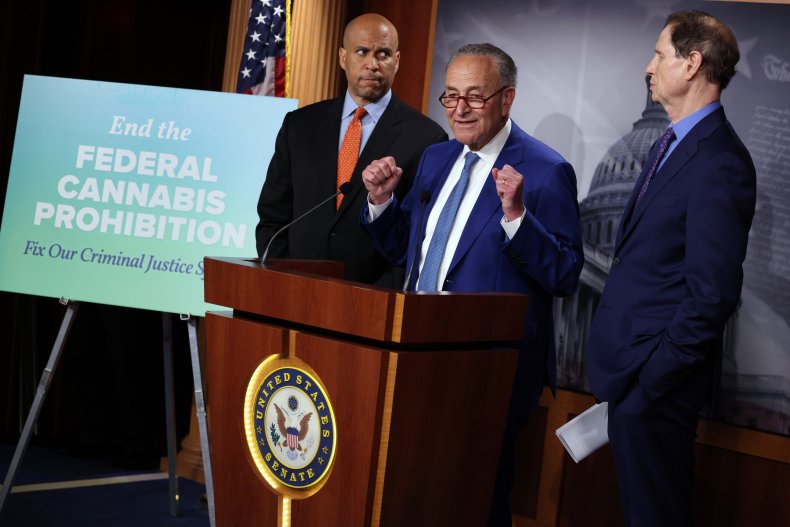
Senate Majority Leader Charles Schumer (D-N.Y.), joined by Senators Cory Booker (D-N.J.) and Ron Wyden (D-Ore.), speak at a press conference on introducing legislation to end federal cannabis prohibition on July 14, 2021.KEVIN DIETSCH/GETTY IMAGES

Recently, the greatly anticipated draft "trio bill"—aptly nicknamed for the three-way cannabis reform effort by Senate Majority Leader Chuck Schumer (D-N.Y.), Senate Finance Chairman Ron Wyden (D-Ore,) and Senator Cory Booker (D-N.J.)—was revealed, intended to spur discussion before a formal bill is introduced. With broad public support and both parties introducing bills to establish legal cannabis at the federal level, cannabis legalization is surely on the horizon.

introducing legislation to end federal cannabis prohibition
Continue reading

Pot activists announce plans to legalize marijuana in Ohio

An organization hoping to regulate marijuana in Ohio has changed routes on legalization. 

The Coalition to Regulate Marijuana Like Alcohol announced Tuesday it will now try passing a state law instead of through a constitutional amendment, which was the original plan, as outlined in March 2020.

“We are proposing to regulate marijuana for adult use, just like we do for alcohol," said Tom Haren, a spokesman for the group, in a statement. "Our proposal fixes a broken system while ensuring local control, keeping marijuana out of the hands of children, and benefiting everyone.”

The coalition submitted its proposal, along with more than 1,000 signatures, to the Ohio attorney general's office on Tuesday. The AG has 10 days to review the summary proposal.

The group would need to collect 132,887 signatures of registered Ohio voters to put the measure before the Legislature.

e-mail icon
Continue reading

WeedLife.com