WeedLife News Network

Hot off the press cannabis, marijuana, cbd and hemp news from around the world on the WeedLife Social Network.

Minnesota Lawmakers Push To Allow Cannabis Flower For Medical Marijuana Patients

A proposed bill in the Minnesota state senate would make it legal for medical cannabis patients in the state to use marijuana flower for treatment.

The legislation cleared its first hurdle earlier this month, with the bill getting passed out of the Senate Health and Human Services Finance and Policy Committee on March 1. According to local television station KSTP, current law in Minnesota only allows medical cannabis to be distributed in pill or liquid form.

Such restrictions have been decried by cannabis advocates, who argue that patients ought to be able to receive treatment in its most common form. Consumption methods like tinctures and oils are also generally more expensive for both the producer and consumer. Former Minnesota Gov. Mark Dayton signed the state’s medical marijuana law in 2014, which has gradually expanded in the years since to include more qualifying conditions. 

Criticism of The State’s Current Medical Cannabis Program

The state’s restrictions have prompted some to call Minnesota’s medical cannabis program one of the most conservative in the country. And those restrictions also prevent many patients from turning to cannabis rather than more dangerous painkillers. 

One member of the Health and Human Services Finance and Policy Committee, state Sen. Matt Klein, expressed tepid support for the bill.

e-mail icon
Continue reading

Colombia Joins International Cannabis Market

Colombia is a country that’s been at the forefront of drug markets for quite some time, with a government ready, willing, and able to make updates to laws as needed. In its newest turn, Colombia is building its international cannabis export market, and creating new legislation to bring in more revenue.

In today’s world of cannabis, you can choose the THC you like the most. There’s delta-9 which is the standard THC. And then there’s delta-8 THC, a newer version which causes less psychoactive reaction, and less overall anxiety. Which THC is better? Check out our sweet Delta-8 THC deals and figure out which one works best for you.

Cannabis and Colombia

Colombia has been one of the more lax countries when it comes to cannabis use, partly because the country has had so many drug issues and drug violence, that it has made laws specifically to try to combat these issues. One of them was to decriminalize most drugs in 1994. This decriminalization wasn’t as precise as it should have been, and in 2012, a specification was made to clarify just how much a person could have for personal use and/or possession without being arrested. The amount was set at 20 grams or less to avoid prosecution. This was still only intended for private use, and did not decriminalize public use.

Things got a little sticky in 2018, when then president Ivan Duque signed a decree giving law enforcement the ability to confiscate personal use quantities if caught. The decree did not break with decriminalization in that it didn’t threaten criminal sanctions, but it did instate a fine of up to 208,000 pesos. The following year (2019) the Constitutional Court ruled that parts of the decree were unconstitutional and abolished punishments for up to 20 grams, while still allowing law enforcement to confiscate contraband.

Sale, supply, and trafficking crimes are all predictably illegal. Having more than 20 grams can be considered possession with an intent to sell. The maximum prison sentence is 20 years, which is a stricter penalty in the country than for rape. Being caught trafficking can land a person in prison for up to 30 years.

Colombia medical cannabis
Continue reading

Inside the Legislation Shaping the Cannabis Industry in 2021

As the COVID-19 crisis persists and many industries suffer while businesses are forced to close their doors, the cannabis market is just getting started.

Over the next year, legislation vital to the emerging business sector is on the docket.

Key bills pending before Congress include the Marijuana Opportunity Reinvestment and Expungement Act, the SAFE Banking Act, Strengthening the Tenth Amendment Through Entrusting States Act, House Amendment 398, Further Health Extenders Act, The Compassionate Access, Research Expansion and Respect States Act, and the Regulate Marijuana Like Alcohol Act.

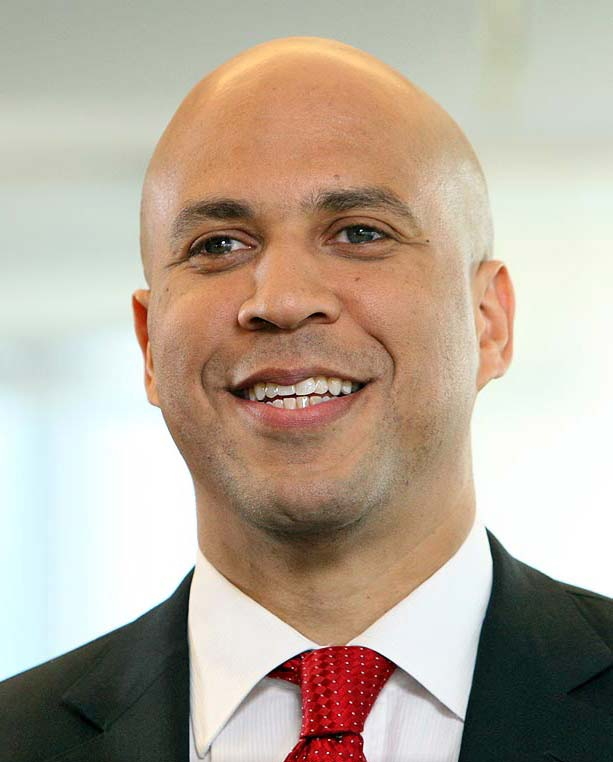
New Jersey Sen. Cory Booker. Photo courtesy of Cory Booker.

New Jersey Sen. Cory Booker, said recently “we have seen the war on drugs be a war on people, and particularly Black, brown, and low-income people.”


Continue reading

Bill proposes regulation of marijuana in Wyoming, $30.7 million per year to school fund

Teton County Representative Mike Yin along with 13 other Wyoming lawmakers are sponsoring a bill outlining the regulation of marijuana in the state of Wyoming. The bill number, HB0209 was assigned yesterday, March 2.

The bill will allow for the sale, purchase, possession, and cultivation of marijuana, regulated by the state of Wyoming. If the bill passes, a person in Wyoming over the age of 21 may possess up to three ounces of retail marijuana, 16 ounces of solid marijuana retail product, 72 ounces of retail liquid product, and 30 grams of retail marijuana concentrate.

Wyomingites over the age of 21 would also be permitted to grow marijuana for personal consumption, with up to 12 flowering female plants and possess up to 16 ounces of retail marijuana in their homes, “provided that any amount more than two and one half (2 1/2) ounces shall be stored in a container or area with locks or other security devices that restrict access to the container or area”

Reps. Jared Olsen (R-Laramie), Mark Baker (R-Sweetwater) Eric Barlow (R-Campbell/Converse), Landon Brown (R-Laramie), Marshall Burt (L-Sweetwater, Cathy Connolly (D-Albany), Karlee Provenza (D-Albany), John Romero-Martinez (R-Laramie), Pat Sweeney (R-Natrona), Cyrus Western (R-Sheridan), Mike Yin (R-Teton) and Dan Zwonitzer (R-Laramie) and Senators Cale Case (R-Fremont) and Chris Rothfuss (D-Albany) sponsored the bill.

HB0209 seeks to establish licensing requirements, production procedures, testing, taxing, and the sale of marijuana. It also generally provides regulations for marijuana-related activities and prohibiting discrimination based on marijuana activities. The bill will outline specific privacy rights, amend criminal penalities, establish civil penalties for the possession of specified amounts, define terms, repeal obsolete provisions, and establish additional offenses related to marijuana.

e-mail icon
Continue reading

Efforts underway to legalize recreational marijuana in Missouri

Could recreational marijuana become legal in Missouri? There are several efforts in the works to make it happen, from legislation to petitions. But not everyone is on board.

Running a dispensary is more than a full-time job.

"It's a lot. It's just 24 hours a day, that’s all we do," said Bianca Sullivan.

Sullivan and her husband, Rob, opened the first medical marijuana dispensary in the Kansas City area. Now, they want to expand to the recreational market.

"We're all for the full legalization of marijuana that nobody goes to jail for and it's not a crime," said Rob Sullivan.

e-mail icon
Continue reading

Washington, D.C. Council Chairman Introduces Cannabis Legislation

Despite being known for its liberal policies, Washington, D.C. still doesn’t have a recreational market. But that could be about to change. 

Council Chairman Phil Mendleson proposed a new, recreational cannabis regulation bill that focused on progress and equity. The bill is also supported by Kenyan McDuffie, Charles Allen, Brianne Nadeau, Brooke Pinto, Christina Henderson, and Mary Cheh, and the focus is deliberately on equity because of the issues the cannabis industry has with inclusion, and the negative impact the war on drugs has on people of color. 

“This legislation is the culmination of over a year of work by my office and external stakeholders,” Mendelson said about the newly proposed legislation. “It creates a comprehensive regulatory framework for the cultivation, production, and sale of recreational cannabis and most significantly, this bill centers reinvestment and opportunity for people and communities hit hardest by the War on Drugs.”

Equity, Justice, Education

This new plan, known as the “Comprehensive Cannabis Legalization and Regulation Act of 2021,” would establish a social equity program, and would make sure that at least half of all those with licensed businesses are equity applicants. Those eligible for equity applicant status would be folks who were formerly convicted of cannabis offenses or residents from areas with high rates of poverty that have been disproportionately impacted by the war on drugs. 

The bill will also set up a cannabis equity and opportunity fund in order to fund those who are eligible for social equity status. As long as cannabis remains federally illegal, it will be difficult to access cannabis funding and support through traditional channels, so the support for equity applicants is essential to make sure they can actually participate in the legal industry. Thirty percent of the tax money generated from cannabis sales will go into this fund. 

e-mail icon
Continue reading

Recreational marijuana is legal in N.J. What happens now?

Recreational marijuana is finally legal in the Garden State.

After a failed bid to pass recreational marijuana in the state legislature, a statewide ballot question overwhelmingly approved by voters, and then disputes over how the new system would look, Gov. Phil Murphy signed three new laws last month effectively legalizing weed for personal use.


But what does that mean? Many aspects of this new paradigm — from the legal marketplace to the implications for policing to the expungement of past convictions — remain hazy.

Here’s what we know and don’t know yet about the state of legal cannabis in New Jersey:

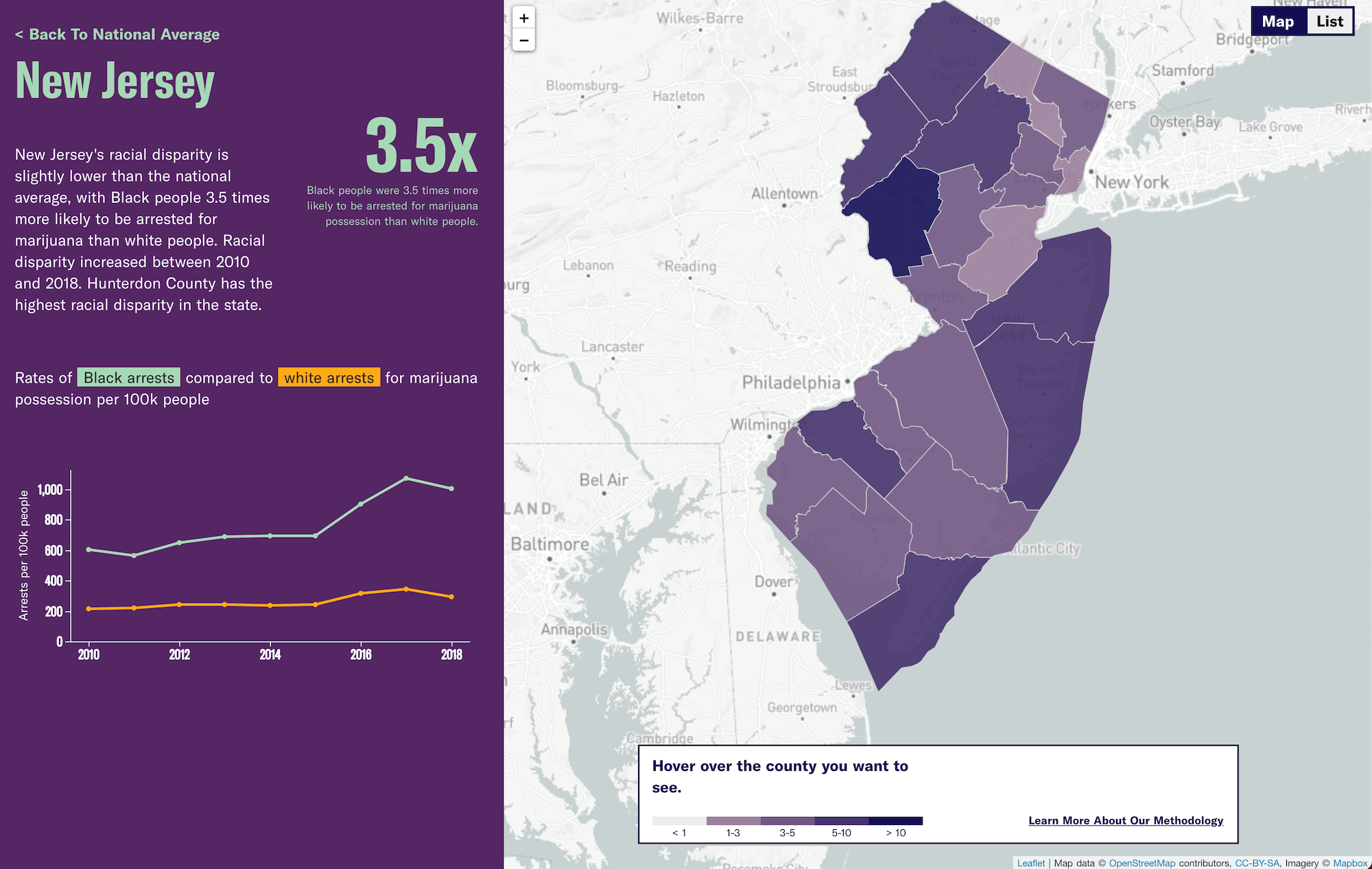
An ACLU graphic shows that Black New Jersey residents were arrested at 3.5 times more than their white counterparts for marijuana possession in 2018.
Continue reading

These 4 Red States Could Go Green In 2021

Legalization could mean millions of dollars for the states as the growth of the supply chain will open multiple opportunities.

The growth of medical marijuana has seen the trend of legalization and opening of new markets prevalent in recent years. Some states that were not leaning towards legalization have greater chances of success this year. More importantly, there is a big possibility for four traditionally red states to make the move to allow medical marijuana programs: Alabama, Kansas, Kentucky, and South Carolina.

A paradigm shift has been taking place carefully since last year and 2021 could help solidify that shift. Many Southeastern states are leaning towards following the trend of Mississippi with respect to marijuana legalization. Likewise, states that normally lean towards the Republican view of things are already embracing cannabis. 2020 showed this reality as Montana and South Dakota legalized medical and recreational marijuana use in November. This makes it 38 states with Washington DC that have medical marijuana programs infused in their state health system.

Legalization for these states will do a whole lot of good given the economic and commercial effects of the 2020 pandemic. Legalization could mean millions of dollars for the states as the growth of the supply chain will open multiple opportunities. Jobs will be created for the populace and the states can hugely benefit from the opening of new economic systems and tax opportunities.

Prospects of the new possible markets

Each of the four states has peculiarities in terms of their road to legalization. Kansas already had two medical marijuana bills squashed last year. Nonetheless, the journey of West Virginia to medical marijuana legalization in 2017 leaves much to expect good news in Kansas too. Though the stakeholders in some of these states seem resilient with prohibition, they will have no choice in the face of a decision made by voters. This was the case of Mississippi where voters used the power of the ballot box to incorporate medical marijuana despite resistance from the legislature.

Which State Will Legalize Marijuana First In 2020- Kentucky, Ohio Or Indiana?
Continue reading

Why Conservatives Should Support Marijuana Legalization

Almost no one used marijuana before it was prohibited. Now, almost 100 years later, it is everywhere.

Disclaimer:The views expressed in this article solely belong to the author and do not necessarily represent those of The Fresh Toast.

As we used to say, back when we could still go to the movies, “This is where I came in. ”

In 1972, the first thing I ever wrote for publication was in the late William F. Buckley Jr.’s National Review on why conservatives should support the legalization of marijuana. It caused quite a stir. There it was on the cover: THE TIME HAS COME: ABOLISH THE POT LAWS.

The New York Times even wrote about it. So did Time (and again in 2015).

I was down the rabbit hole. So now, 49 years later, when I saw “There’s a Responsible Way to End the Federal Marijuana Ban. The key to any nationwide legalization is to “keep the free market out of it” by Ramesh Ponnuru, a senior editor for National Review, I just had to respond with Conservative Intellectual Wants To Keep Marijuana In The Black Market So “Problem Users” Won’t Be Such A Problem.

Why Does Congress Need Two Years To Federally Legalize Marijuana?
Continue reading

NM lawmakers face looming challenge to marijuana legalization

This year's 60-day legislative session has 20 days left, and lawmakers in the Senate have four proposals to consider.

On Saturday, members of the Senate Tax, Business and Transportation Committee hashed out those initiatives with the bills' sponsors for nearly four hours. It was the first time the bills received a hearing in the Senate — a point brought up by Sen. Craig Brandt, R-Rio Rancho.

"This was supposed to be a priority issue and yet we have 20 days left and we’re just hearing it," he said, urging his fellow members on the committee to move at least one of the four bills forward to the Senate Judiciary Committee for consideration to get the ball rolling. 

But in the end, the sponsors of the four proposals — House Bill 12 and Senate bills 13, 288 and 363 — were told to get together over the next week and come up with just one proposal for the committee to vote on March 6. 

That will leave lawmakers just two weeks to move the chosen initiative through the Senate Judiciary Committee and then to the Senate floor for a final vote. 

e-mail icon
Continue reading

Connecticut Governor Makes Plan To Legalize Cannabis

Connecticut Governor Ned Lamont would like to see legal cannabis in his state, both because he would like to bring more money into Connecticut, and because he hopes legalization will help end racial disparity in arrests in the state. To make this a reality, he has introduced a bill to the legislature. 

While Lamont realizes that this plan may take some extra convincing, since Republicans are likely to fight back throughout the legislative process, and Democrats would like to see an even more liberal bill, he feels good about being able to come up with a solution. 

“This is the beginning of a discussion, not the end of a discussion,” he said regarding the proposal. “This has been a long time coming. We have been talking about this for ages,” Lamont said. “I think now is the time for legalized adult-use recreational marijuana in a carefully regulated way with an emphasis on equity and justice.”

The bill focuses on decriminalization, regulation, and generating revenue when it comes to the proposed, legal industry. This Friday, the state will hold a public hearing about the proposal. 

If legalization passes, sales could begin in May of 2022. Projections reveal that Connecticut could raise as much as $33.6 million for the 2023 budget, and $97 million by 2026. 

e-mail icon
Continue reading

Idaho Senate Approves Constitutional Ban On Marijuana

The Idaho Senate has passed a resolution that bans the production, sale, and possession of cannabis in the state. The decision is in sharp contrast to what lawmakers and voters are doing in other states.

If passed by the Idaho House of Representatives by a two-thirds margin, the measure would go in front of voters on the midterm election ballot. If passed by voters, it would effectively prohibit cannabis legalization in the state, even if voters later approved it. 

Interestingly, debate on the bill was something of a throwback to the last century, with a significant portion of it revolving on terms that seemed to address the morality of using cannabis.

Idahoans like cannabis, but politicians want to do “what’s right.”

Part of the debate on the cannabis ban centered on issues of right vs. wrong. One Republican senator choked up during debate over the bill, saying: “Good senators, I beg you: we have to keep this state clean,” according to Boise State Public Radio. 

The Idaho Senate’s decision is particularly interesting when you consider how popular marijuana is to actual Idahoans. They frequently cross the Oregon border to buy marijuana. State officials in both Oregon and Washington have reported that some of the counties with the highest amounts of cannabis sales are along the Oregon border.

e-mail icon
Continue reading

Virginia Lawmakers Pass Bills Allowing Herbal Forms Of Medical Marijuana

The Virginia legislature has passed bills to modify the state’s medical marijuana program to allow for the production and sale of herbal forms of cannabis. The measures, House Bill 2218 and Senate Bill 1333, were approved this week with overwhelming majorities in both the House of Delegates and the Virginia Senate.

The legalization of medical marijuana in Virginia began with a strictly limited 2015 law that allowed for CBD and THC-A oils to be used by patients with severe epilepsy. The regulations have been loosened since, and medical marijuana dispensaries selling products with up to 10 milligrams of THC per dose opened in the state last year.

Under Virginia’s current laws, the state medical marijuana program only allows processed forms of cannabis, such as tinctures, edibles, and oils. Herbal forms of cannabis including smokable marijuana are not permitted. With the new change, regulated medical marijuana producers will be permitted to offer products made from “cannabis oil or botanical cannabis,” according to the text of the legislation.

The medical marijuana industry and advocates lobbied for the addition of herbal forms of cannabis to the roster of legal products as a way to improve affordability for patients. The change is expected to greatly increase the number of patients with physician recommendations for medical cannabis, which now totals about 10,000.

Activists Laud The Change

Jenn Michelle Pedini, the executive director of the Virginia chapter of the National Organization for the Reform of Marijuana Laws (NORML), said in a press release that the change will make patients’ medicine accessible in the form many prefer.

e-mail icon
Continue reading

The U.S. Hemp Authority Releases Newest Certification Standard

The U.S. Hemp Authority announced it has released Guidance Procedures 3.0, a revised version of the 2.0 standards. 

The organization creates regulatory standards and certifies hemp and CBD businesses through third-party auditing.

“The revised version is a reflection of the strong intention of the organization to continue measures of improvement to apply lessons learned about the new industry, and reflect broad and deep public input,” the organization states in a news release.

The changes from version 2.0, which was implemented in 2019, include new regulations from the U.S. Department of Agriculture (USDA) and revisions that are designed to help clarify expectations for farmers, with additional insights from another year of experience gained by the industry, the release states.

According to the summary of changes, some revisions from version 2.0 include a new introduction section to describe the program’s intentions and objectives. The glossary has also been updated to revise definitions and remove unnecessary terms. 

e-mail icon
Continue reading

New Study Suggests Link Between Cannabis Legalization And Decline In Workers Comp Claims

A new research paper from the National Bureau of Economic Research suggests a connection between marijuana legalization and a decline in workers’ compensation claims.

The study, conducted by a team of researchers from  William Paterson University, Temple University, University of Cincinnati-Blue Ash and the RAND Corporation, examined “the effect of state recreational marijuana laws (RMLs) on workers’ compensation (WC) benefit receipt among adults 40-62 years.”

“Marijuana has increasingly become legalized in the United States. We study the effects of recent state laws that legalize the recreational use of marijuana on work capacity—the ability to productively engage in paid employment—among older working-age adults,” the researchers wrote in the study’s introduction. “We rely primarily on Workers’ Compensation (WC) benefit receipt as a signal of diminished work capacity; WC benefits are received when individuals become injured or ill while working and require time away from work to recover. In addition to providing a useful measure of labor productivity and work capacity, injuries incurred while working represent substantial costs to the national economy.”

They found that workers’ compensation receipt “declines in response to [recreational marijuana laws’] adoption both in terms of the propensity to receive benefits and benefit amount.

“We estimate complementary declines in non-traumatic workplace injury rates and the incidence of work-limiting disabilities,” they wrote. “We offer evidence that the primary driver of these reductions is an improvement in work capacity, likely due to access to an additional form of pain management therapy.”

e-mail icon
Continue reading

North Dakota House votes to legalize recreational marijuana

North Dakota Representatives gave the green light to recreational marijuana.

The House voted Tuesday morning to legalize marijuana for recreational use for adults 21 years or older.

This bill would also allow people to be able to grow or possess marijuana.

“There’s a lot of things I don’t agree with, but if it’s good policy and I think it’s going to be for the betterment of the State of North Dakota, I vote for it. And so I ask for a green vote,” said Rep. Jason Dockter, from Bismarck.

“Let’s vote green,” said Rep. Pat Heinert, from Bismarck.

e-mail icon
Continue reading

Marijuana, hemp businesses move one step closer to banking in South Dakota

Marijuana and hemp-related businesses are one step closer to gaining access to South Dakota banks.

House Bill 1203 proactively lays groundwork for banks and their subsidiaries to work with any person that acquires an industrial hemp or marijuana license, pending legalization of the substances at the state level. The legislation passed in the state House of Representatives on Monday afternoon with a vote of 64 in favor, four opposed and two excused.

Without a bill of this kind, those involved in cannabis industries would only be able to carry out business transactions in cash, as marijuana is considered an illegal business at the federal level.

The legislation’s prime sponsor Rep. Hugh Bartels, R-Watertown, noted during Monday’s session that banking in industrial hemp and marijuana is “heavy in compliance” issues, and that not all banks will choose to opt into working with these industries.

No state representatives besides Bartels spoke on the bill.

e-mail icon
Continue reading

Hemp is NOT Marijuana: but it is a potential windfall for the Dominican Republic

Industrial hemp has a less than 0.3% THC (Tetrahydrocannabinol, the psychoactive agent in Marijuana) level.
Furthermore, hemp was removed from its classification as a controlled substance.

The Farm Bill contains a change of how industrial hemp is now classified.

Under the Farm Bill, hemp is no longer considered a controlled substance non-hallucinogenic cousin of marijuana; hemp has been considered a controlled substance because it has that tiny amount of THC. However, hemp has about as much chance of getting someone high as honeybuns have got someone drunk (honeybuns contain a correspondingly small amount of alcohol.)

So, other than a wholly undeserved stigma created by an industrial juggernaut engaging its political allies to remove its biggest competitor through a campaign of utter falsehoods and racially-charged exaggerated fabrications: there is absolutely no reason not to farm hemp and reap all the socio-economical benefits from farming hemp in 2021. None.

The pathway to a uniquely versatile product that produces millions of dollars within 100 days has been approved, cleared, and green-lighted by the Biden Administration and the US government. On a planet whose atmospheric composition has become a bit too heavy with carbon dioxide lately, the carbon-sequestering ability of hemp offers yet another win-win scenario. The more hemp planted, the more CO2 neutralized.

e-mail icon
Continue reading

New Hampshire marijuana legislation still in play at the State House

For years, the pattern has held: The New Hampshire House recommends fully legalizing the recreational use of marijuana in the Granite State, and the Senate shoots the measure down.

Perhaps not this year.

In a notable move late last month, the House Criminal Justice Committee recommended that the 400-member body scrap two bills that would greatly loosen marijuana laws in the state. After one hearing, the committee recommended putting off until next year House Bill 237, which would legalize the use marijuana, and House Bill 629, which would legalize it and allow growing at home.


The 14-7 vote was opposed by seven Democrats on the committee.

e-mail icon
Continue reading

Wisconsin Republicans Want To Throw Out Legalization Efforts

As many feared and expected, Republican senators are objecting to Democratic Governor Tony Evers’ proposed budget for Wisconsin, which includes legal cannabis. 

In addition to advocating for federal legalization, the budget talks about some other, progressive concepts, including raising the minimum wage, reforming the juvenile justice system, and expanding medicaid access. 

“I would describe his budget as a liberal’s dream,” said Sen. Howard Marklein of Spring Green in response to the proposal. Marklein and Rep. Mark Born of Beaver Dam are standing against the proposed budget. 

This is not the first time Republicans rewrote much of the proposed Wisconsin budget. The same thing happened in 2018. That year, cannabis legalization was also removed. 

With this current budget, Evers is arguing that the $165 million a year brought in could support those in rural areas and those in need of social equity support. 

e-mail icon
Continue reading

WeedLife.com