WeedLife News Network

Hot off the press cannabis, marijuana, cbd and hemp news from around the world on the WeedLife Social Network.

Marijuana use is becoming the new normal, according to data

Cannabis consumers are increasing across legal states, with polls showing that they’ll soon become the new normal.

Marijuana’s increase in popularity continues to surprise everyone over the age of 18, with a new poll showing that the drug is well on its way to becoming the new normal.

The numbers, reported by a study from the University of Michigan, show that more and more young adults living in legal states are regularly consuming marijuana.

The data shows that over two-fifths of young adults across the nation consume cannabis occasionally. These figures are growing alongside the number of states that are legalizing the drug, which now stands at 19.

Researchers also share that the jump in numbers is driven in large percentages by women. The study’s data show that this change is a marked departure from the numbers belonging to previous generations, when men were the principal marijuana consumers, or, at least the ones who were open with polls about their cannabis habits.

Young cannabis smokers in Colorado and Washington, DC are about to overcome the majority on nonsmokers. In Vermont, which legalized marijuana this month, young smokers are already the majority.

The Hill spoke with several young adults from states where cannabis is on the ballot in November, who shared why they enjoyed marijuana and why their generation was so open to its use. “It really helps with sleep,” said Allison. “It’s great for stress, anxiety. And my generation has huge anxiety problems.”

Earlier this month, the Biden administration issued a pardon for non-violent cannabis offenses, asking governors and state leaders to follow their lead. Per Biden, one of the main reasons behind the pardons is social justice, hoping to benefit minorities and those who’ve been impacted by the war on drugs.

e-mail icon

Copyright

© 420 Intel

20 State Cannabis Dispensaries are supposed to open this year

But Not A Single Location Has Been Announced Yet. The delay in Gov. Hochul's plan could jeopardize promised licenses for retailers with weed-related convictions.

Gov. Kathy Hochul says New York is “on track” to open some cannabis dispensaries within months — but industry leaders say they see only red signals ahead.

The state government set a goal of opening dispensaries by the end of the year that’ll allow New Yorkers to legally purchase cannabis. Hochul told the editorial board of Advance Media, owner of Syracuse Post-Standard, the state would open 20 dispensaries by the end of the year, with another 20 openings each month after.

Her plan is propped up by a $200 million loan fund to help people who have been negatively affected by weed-related convictions open their retail shops, with the first 150 licenses reserved for those with past records.

But players participating in the process warn the timetable may be unrealistic.

“We were really hoping for retail stores to be open on or around the time that cultivators were harvesting, it seemed like the best case scenario. But we’re really just not sure where these first retail stores are supposed to be,” said Dan Livingston, the executive director of the Cannabis Association of New York, a trade association.

e-mail icon

Copyright

© 420 Intel

Majority of Minnesotans support legalization of hemp and marijuana-derived edibles

Support was similar across genders, ethnicities and education levels, but varied by party affiliation and age.

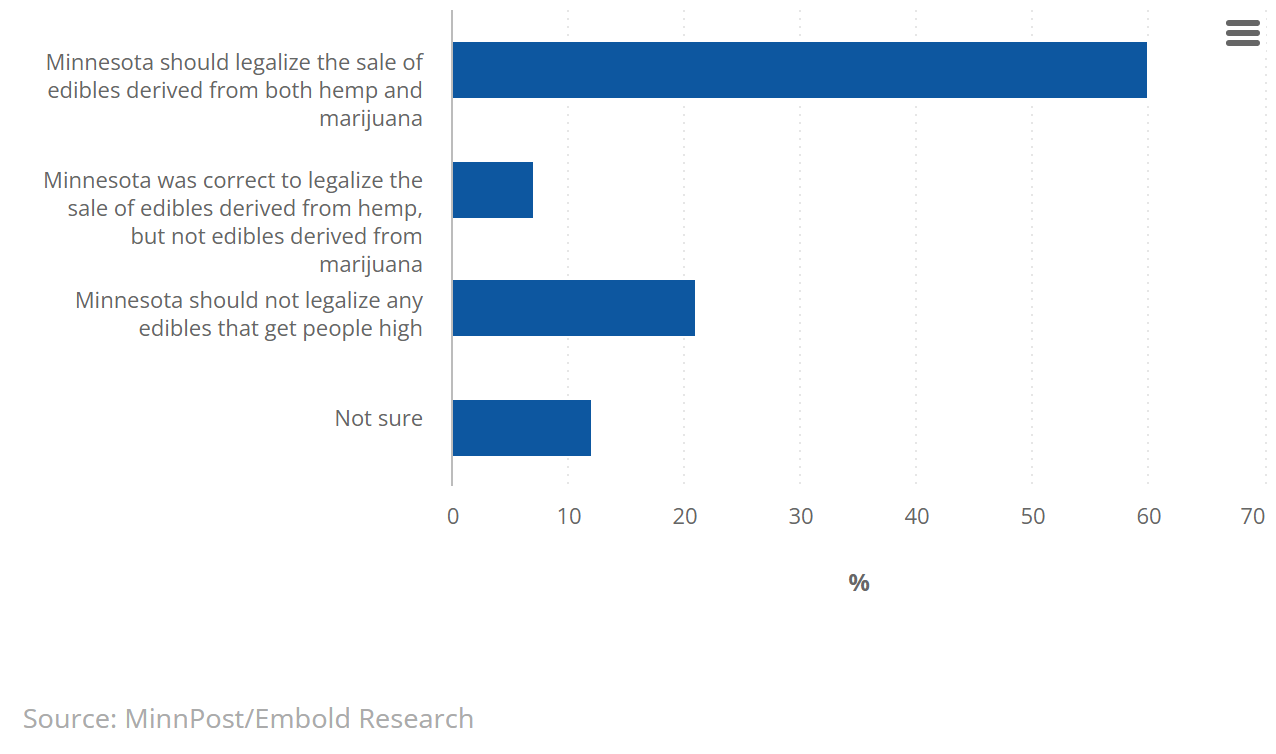
A majority of Minnesotans surveyed as part of a new MinnPost/Embold Research poll say they support the state legalizing intoxicating THC edibles and beverages derived from hemp — which happened in July — and said the state should legalize marijuana-derived edibles.

In 2012, Colorado and Washington became the first states to legalize recreational marijuana use. Since then, 19 states and the District of Columbia have made marijuana legal for recreational use, according to the National Conference of State Legislatures.

In Minnesota, medical marijuana has been legal since 2014, but efforts to make the substance legal for recreational use have failed to gain traction. But this year, a controversial piece of legislation made edibles derived from hemp — not marijuana — legal in the state for adult recreational use.

The law, which went into effect July 1, allows for the purchase of food and beverages with up to 5 milligrams of THC per serving while placing a limit of 50 milligrams per package. It came as a surprise to many after its passage, with some elected officials admitting they weren’t aware of the scope of the bill when it passed. The law doesn’t include provisions for regulation, taxation or enforcement, prompting some local governments around the state to develop their own enforcement rules.

Still, the poll suggests the regulatory change making THC edibles and beverages legal in Minnesota is popular with Minnesotans: 60% of the poll’s respondents said they believe Minnesota should allow the sale of THC edibles and beverages made from both hemp and marijuana. Another 7% of those polled say the new law allowing hemp-derived products works for them but don’t support the legalization of products made from marijuana. Crosstabs can be found here.


Copyright

© 420 Intel

Recreational marijuana is the future

It’s time Iowa joins the winning team and legalizes marijuana.

Individuals with a federal charge for marijuana possession are no longer criminals.

President Joe Biden declared a pardon on Oct. 6 for thousands of individuals with a “simple marijuana possession.” Any other crimes that relate to marijuana are excluded.

Iowa should follow this example of clemency by decriminalizing recreational marijuana. Decriminalizing marijuana will create more equitable communities and give the state a stream of revenue.

Iowa is one of 31 states that criminalizes recreational marijuana use.

“As I said when I ran for president, no one should be in jail for using or possessing marijuana,” Biden said in a statement. “It’s already legal in many states, and criminal records for marijuana possession have led to needless barriers to employment, to housing, and educational opportunities. That’s before you address the racial disparities around who suffers the consequences.”

e-mail icon

Copyright

© 420 Intel

As election day nears, debate over Marijuana heats up

RAPID CITY -The debate over the recreational marijuana issue continues. However, according to a federally funded survey, youth marijuana use decreased significantly in 2021, as well as teen consumption of illicit substances overall.

“Colorado’s 171 million dollars was appropriated strictly to education; that’s educating our youth on the effects of marijuana and what that looks like, and that’s resources well-spent. Other tax revenues went to drug addiction, law enforcement, roads and infrastructure amongst building brand new schools and a wide variety of things that can help benefit the South Dakota community,” says proponent Kittrick Jeffries, CEO for Puffy’s Dispensary

Jim Kinyon, chairman for Protecting South Dakota Kids, counters by saying some Colorado resident, have moved to South Dakota because of the negative impact cannabis has had on Colorado.

“We don’t lock up people for marijuana. We try and get them healthy,” said Kinyon, “In the state of South Dakota, if this gets legalized, we’re leaving South Dakota because our kids and our families won’t be safe.”

Meade County Sheriff-elect Pat West says you would be allowed to grow up to three or six marijuana plants in a household but no more than an ounce of product.

“So if they’re allowed to have six marijuana plants in a house, that means you can grow up to 60 pounds of marijuana every three months; that’s an excessive amount of marijuana,” said West.

e-mail icon

Copyright

© 420 Intel

Thousands more pets are getting sick from accidentally eating Marijuana

The ASPCA Animal Poison Control Center reports that it handled more than 6,200 cases of potential marijuana toxicity in 2021.

A few days ago, I arrived home to find my beloved 12-year-old dog in a semi-comatose state. She couldn’t move her back legs. She flinched when I touched her elsewhere. She was “out of it” in a way that almost suggested she might be experiencing a very bad trip.

As it turns out, that’s exactly what was happening. The 16-pound Lulu was suffering from marijuana toxicity, as I learned after rushing her to an emergency vet.

At first, I was confused: My wife and I don’t keep marijuana in the house. But we do take Lulu out for two walks a day in our New York City neighborhood. The vet suspected Lulu probably found the marijuana, whether in plant or edible form, somewhere along our morning stroll and then ingested it, with the drug taking full effect hours later.

The vet added that this is becoming almost an everyday occurrence in her practice: Dogs like to eat whatever they come upon in the streets — or in the home — and the consequences can sometimes be medically serious.

I always knew that chocolate was hazardous for dogs. Same with rat poison, which can also be found on city streets. But marijuana? And was this really occurring on a regular basis?

e-mail icon

Copyright

© 420 Intel

Rise of Cannabis-Friendly vacation rentals

The vacation rental market is getting a 420-friendly renovation as some industry business owners are starting to offer cannabis at select rental locations.

With cannabis growing beyond the traditional confines of dispensaries and cultivation sites, the hospitality space appears to be the next big industry endeavor despite current regulations lagging behind the mainstream interest.

Sites like BudandBreakfast.com and Vibesbnb.com are two options that connect guests with hosts who allow marijuana use on their properties. Some properties provide more than just a space to use cannabis – specific rentals can offer a variety of cannabis experiences and activities like yoga, massages, and sometimes even cannabis education classes. Comparable to navigating VRBO or Airbnb’s site, BudandBreakfast and Vibesbnb allow potential visitors to search by location, price, amenities, and available facilities.

Upon the property’s booking, the rental owner designates specific smoking areas for guests. Rental owners also have the option to provide cannabis for guests or specify if guests need to bring their own. This novel business model is proving to be immensely popular – some rental spaces are currently booked six months in advance.

As of now, BudandBreakfast hosts 2,000 listings – a much smaller market than VRBO and Airbnb’s listing reach. Despite the limited cannabis rental properties now available, analysts expect huge returns for cannabis tourism. Forbes predicts that tourism for cannabis is a $17 billion industry.1 Combined with cannabis sales estimates projected to climb from $25 billion in 2021 to $42 billion in 2026,2 it is clear that the industry has the capital to develop into tourism and hospitality fields.

Beyond the aforementioned rental websites, many individuals are actively seeking to break new ground with cannabis-friendly spaces across the country. In Washington D.C., Nicole Butler manages a bed-and-breakfast where she greets guests with cannabis products.3 To amplify the ‘bed-and-breakfast’ aspect of the rental, she provides guests with a variety of cannabis-infused snacks and food.

e-mail icon

Copyright

© 420 Intel

Marijuana legalization could complicate drug-sniffing work by police K9s

With legalization of marijuana on the ballot in November, some in Frederick County law enforcement might see changes in their job descriptions — narcotics K-9s.

K-9s can be trained in different skills, such as tracking people, identifying guns and physical apprehension. Narcotics K-9s are trained in identifying various substances such as heroin, fentanyl and marijuana.

A possible change in the state constitution through a referendum would legalize the use of marijuana for any individual who is at least 21. If passed, it would take effect July 1, 2023.

Agencies like the Frederick County Sheriff’s Office stopped training their dogs in identifying marijuana in 2014, when possession of less than 10 grams was decriminalized, said Capt. Jeff Eyler, the agency’s patrol operations commander.

The agency saw that Maryland could potentially make marijuana fully legal in the coming years, so it proactively stopped marijuana training, he said.

The sheriff’s office had concerns about probable cause on searches, he said.

e-mail icon

Copyright

© 420 Intel

Biden pardons thousands: is it enough?

On Oct. 6, President Joe Biden announced new efforts his administration is taking to reform the drug policy.

This includes taking steps to decriminalize marijuana, beginning with pardoning all people who have been convicted of marijuana possession under federal law. This does not include people who have been convicted of selling or distributing marijuana illegally. 

Biden also asked for the Secretary of Health and Human Services, Xavier Baccara, and Attorney General Merrick Garland to review the federal status of marijuana, according to Politico. Marijuana is currently classified as a Schedule I Drug under the Controlled Substances Act, meaning that it has no acceptable medical purposes and is highly addictive.

This categorizes marijuana with drugs such as heroin, LSD and ecstasy, and it prohibits all marijuana use according to the Drug Enforcement Administration. Lowering marijuana’s classification to a Schedule II Drug would put it in the same category as most opioids, and it would allow marijuana to be prescribed by doctors, according to Reuters. 

Criticisms of the efforts have come from both sides of the aisle. Some Democrats and progressives see the efforts as a step forward, but not eliminating major problems, considering the pardons impact relatively few people. According to Reuters, there are not many federal convictions for simple marijuana possession, and the administration says the pardons will affect 6,500 people. As a result, many activists say that this does not address the heart of the problem.

Although this will not result in people leaving prison, it will clear the records of those affected, allowing them to gain employment opportunities, apply to colleges and obtain other opportunities to help them move forward with their lives. Biden also acknowledged that many people are convicted under state or local laws, according to Reuters. He encouraged governors to pardon people convicted of simple marijuana possession under state laws.

e-mail icon

Copyright

© 420 Intel

Government of Yukon completes handover of cannabis retail sales to private sector

The Yukon’s cannabis licensees now operate all retail locations, online sales and delivery.

As of 17/10/2022, the Yukon Liquor Corporation’s Cannabis Yukon website will no longer sell cannabis products to Yukoners, leaving cannabis e-commerce to private licensees.

In May 2022, the Government of Yukon introduced regulations that allow licensed cannabis retailers in the Yukon to sell and deliver legal cannabis products to Yukoners. This fulfilled the Government of Yukon’s commitment to support the Yukon’s private cannabis industry.

I am pleased to fulfill our commitment to transfer all cannabis retail, including online sales, to the Yukon’s private, licensed retailers. The Yukon’s cannabis industry continues to see year-over-year growth and I look forward to seeing the  industry continue to thrive, responsibly serve Yukoners and contribute to our territory’s economy.

Minister responsible for the Yukon Liquor Corporation Ranj Pillai

Quick facts 

Cannabis Yukon opened in October 2018 and closes today. The website is being re-purposed to provide wholesale purchasing options to the Yukon’s licensed retailers.

e-mail icon

Copyright

© 420 Intel

Switzerland fully legalises medicinal cannabis

Philippe Reich, partner, and Tiziana Hongler, associate, supported by Tanya Adams and Anna Bachmann at Baker McKenzie in Zurich, investigate a significant development in modernising Switzerland’s legislation on cannabis

On August 1, 2022, Swiss National Day, Switzerland’s revised Narcotics Act (NarcA) entered into force. The revision aims at facilitating medical treatments and improving research and development of cannabis.

Prior to the revised law, patients and physicians had to apply for special authorisation from the Federal Office of Public Health (FOPH) if they wanted to access cannabis for medical purposes. The amendment will allow numerous patients safe and timely access to cannabis medicines as part of their treatment regime.

According to a study by the Institute for Addiction and Health Research carried out on behalf of the FOPH, 96% of participants reported that the consumption of medicinal cannabis led to an improvement of their symptoms. In light of cannabis’s potential as a medical treatment and the surge in applications and high approval rates of the FOPH in the last few years, the costly and time-consuming procedure physicians and patients had to undergo to obtain authorisation for treatment with medicinal products containing cannabis was no longer justified. This led to the latest revision of the NarcA, which focuses on the legalisation of medicinal cannabis, making cultivation, processing, production and trade thereof subject to the authorisation procedure of Swissmedic in the same way as other narcotics that are used in a medical context.

Key takeaways

The main features of the amendment include the following:

Every licensed physician is now able to prescribe medicinal products containing cannabis as part of the general principle of therapeutic freedom, and special authorization by the FOPH is no longer requiredThe cultivation, production, processing and trade of medicinal cannabis is now subject to the authorisation procedure of SwissmedicA two-stage authorisation procedure has been established for the cultivation of cannabis plants for medicinal purposes

Background

Prior to the enactment of the revised law, cannabis with tetrahydrocannabinol (THC) levels of 1% and above were classified as prohibited narcotics in Switzerland. As a result, cannabis with THC levels of 1% and above could not be cultivated, produced, imported or placed on the market. This limited the medicinal use of cannabis, which was subject to a case-by-case authorisation requirement from the FOPH.

e-mail icon

Copyright

© 420 Intel

Gadsden joins Glencoe in passing ordinance opening door for medical cannabis industry

The State of Alabama gave its OK to medical cannabis more than two years ago, and the process of making that a reality — from growing it to getting it to patients in need — will begin in coming months as the application process for the limited number of business licenses begins.

For cites and counties to have a shot at landing one of those businesses, their governing bodies must approve an ordinance saying they are open to cannabis-related industries.

The Gadsden City Council approved that ordinance last week, seeking to be added the state's list of approving cities or counties by Oct. 17 — the deadline set by the Alabama Medical Cannabis Commission for requests for licenses for businesses related to medical cannabis.

Gadsden joins Glencoe — the only other Etowah County site listed — Tuscaloosa, Montgomery and 15 other municipalities or counties.

There are a limited number of licenses to be granted, City Attorney Lee Roberts told Gadsden council members. "It's going to be very competitive," he said, when it comes to landing these industries.

Council member Jason Wilson said it's estimated that one of these licensed dispensaries could generate $20 million in sales, which would be subject to sales tax.

e-mail icon

Copyright

© 420 Intel

Cannabis Companies can raise money using credit cards with KoreConX Technology

Whether these companies are using RegA+, RegCF or RegD, they are now able to accept investments via credit cards from investors using KoreConX All-In-One Platform, without the abusive high fees normally charged from companies in this sector

NEW YORK - KoreConX's innovative approach to the cannabis ecosystem enables companies to raise money by accepting credit cards. It sounds like a simple solution, but it can actually revolutionize how the sector operates. Using the exemptions of Regulation A+, Regulation CF or Regulation D, companies can easily turn their customers and brand advocates into shareholders.

KoreConX has enabled credit card acceptance and escrow providers in their platform, ending the issue of high fees that were traditionally charged from this sector due to a perceived higher risk and lack of nationwide legalization, especially in the USA. Although legal for medicinal and adult recreational use in some states, there are still obstacles that cannabis companies face regarding their capital needs.

Nonetheless, President Joe Biden's announcement that all federal convictions for simple marijuana possession were to be pardoned is a milestone in the continued growth of the cannabis sector. According to Grand View Research Institute, market size was valued at USD 13.2 billion in 2021 and USD 16.7 billion in 2022, with a revenue forecast of USD 102.2 billion for 2030, which would represent a compound annual growth rate (CAGR) of 25.5% from 2022 to 2030. 

Secure platform

Companies in the cannabis sector had found it difficult to raise capital in the traditional capital markets, making the private capital market a more viable option. KoreConX All-In-One Platform uses its proprietary solution based on blockchain - the KoreChain - to make transactions and shareholder management safe for investors and entrepreneurs.

e-mail icon

Copyright

© 420 Intel

Cannabis lands a Homerun: major league baseball signs deal with CBD Company

In a recent announcement, Major League Baseball announced a sponsorship deal with cannabidiol (CBD) company Charlotte’s Web.

Major League Baseball (MLB) is continuing to be a breakout star in the cannabis industry. In 2019, they removed cannabidiol (CBD) from its list of banned drugs (1), which was the first US sports league to do so. Now, the MLB is the frontrunner again by striking a sponsorship deal with cannabidiol (CBD) products maker Charlotte’s Web, the first of the four major US sports leagues to reach a deal with a CBD company (2).

CBD is a cannabinoid known for its medicinal uses to relieve pain and alleviate stress. Charlotte’s Web Holdings Inc. produces a variety of CBD products such as tinctures, topical sprays, and gummies. The MLB’s press release (3) stated, “The rigorous approval process that brought the two legacy brands together fills a major gap in the sports channel for an NSF Certified for Sport® portfolio of CBD products for players and consumers demanding safe, natural options to support recovery, help keep calm under pressure, and help sleep cycles and focus.”

In June, the US Sport league officially allowed clubs to form sponsorships with CBD companies that are certified for sport by The National Science Foundation (NSF), which is an institution that inaugurates standards for products used by athletes. Numerous celebrities and athletes have endorsed CBD products. For example, Hall of Fame National Football League (NFL) running back, Terrell Davis, partnered with investors in 2018 to produce a CBD-infused sports drink (2).

The newly formed partnership between the MLB and Charlotte’s Web arrives as the CBD maker releases a product called Daily Edge, a tincture that is also the first CBD product to be certified for sports by NSF. The item will feature the MLB logo on its bottle. The US Food and Drug Administration (FDA) has yet to certify CBD products, but that hasn’t stopped the cannabinoid from growing in popularity. As reported in 2021 (2), the US CBD market hit $4.7 billion in total sales. The MLB and Charlotte’s Web three-year deal is worth $30.5 million (1). One of the deal’s components will be to promote Charlotte’s Web products during games, as well as on the MLB’s social media platforms, streaming digital channels, and during post-season games. The leagues fanbase is estimated around 180 million fans, which will bring a different geographic of customers to Charlotte’s Web.

"Wherever you see MLB, you'll see Charlotte's Web," Jacques Tortoroli, CEO of Charlotte's Web, told CBS on their MoneyWatch program (1). "What we're about is making sure there's calmness of the mind so you can perform your best."

Also included in their partnership, the MLB obtained an estimation of 6.1 shares of Charlotte’s Web (1). The CBD company also is required to pay the MLB a 10% royalty on any products sold that have the MLB branding on it after the total sales exceed $18 million. Shortly after the MLB’s announcement, Charlotte Web’s stock rose nearly 25% and traded at 75 cents a share.

e-mail icon

Copyright

© 420 Intel

Pelican Delivers in talks with Tesla to create new Cannabis Delivery Vans

The collaboration would be the first of its kind in the history of the world.

BREMERTON - Pelican Delivers is thrilled to announce it is currently in talks with Tesla to create and produce vans specifically for delivering cannabis.

Pelican Delivers is the first and only, on-demand patented cannabis delivery service in the United States and Canada. The company collaborates with state/province-licensed cannabis stores to purchase products and then deliver them directly to the consumer, utilizing innovative technology to facilitate dynamic workflow of orders, real time lead generation for drivers, escrow, release and transfer of funds and authentication of customer identity prior to delivery. Pelican Delivers strives to always comply with both state/provincial laws and interstate commerce.

In the company’s most exciting news to date, Pelican Delivers is collaborating with renowned electric automotive company, Tesla, to design and manufacture delivery vans specifically created for delivering cannabis. The historical announcement comes at a time when electric vehicles are wildly sought-after for both individual and commercial use, and when cannabis use is at an all-time high.

“We couldn’t be more pumped about our concept of electric cannabis delivery vans,”
says founder and CEO of Pelican Delivers, Dave Comeau. “This is an idea we’ve had for some time, so to be in current talks with Tesla about our vision is such a humbling experience. We can’t wait to see what the final product will look (and drive) like.”

About Pelican Delivers

Founded by husband-and-wife team Dave & Tina Comeau in 2017, Pelican Delivers is an on-demand nationwide patented cannabis delivery service, which officially started in 2018. Prior to Pelican Delivers, Dave was the IT Supervisor at one of Washington State’s largest Tribal Casinos. Having gained this casino experience, Dave and his family opened the Ponderay Café & Casino in Bremerton WA, where he was the general manager. In 2010, Dave was a Medical Marijuana Grower and processor where he grew the business from one small tent in his garage to an 8,000 sqft warehouse. In 2016, Dave opened a chain of retail cannabis stores (Better Buds) in Washington State with annual revenue over 16 million.

e-mail icon

Copyright

© 420 Intel

Beets and cauliflower: Cannabis-infused vegetables are weak competition to black market

Cannabis became legal in Canada four years ago, and while Quebec was slow to introduce edibles, a new selection of ready-to-eat pot-infused foods are now available.

The SQDC’s edible cannabis catalogue includes items like dried beets, cauliflower and figs – a notable departure from what consumers might expect to see at their local dispensary.

Unlike other provinces, which sell candy-like edibles, the sale of cannabis chocolates and gummies are off-limits in Quebec, because they could appeal to children.

But some fear that Quebec’s hesitancy to embrace candy and sweets-based edibles could backfire as weak competition to the black market.

“If we want to kill the black market, we do have to offer the consumer what they want,” said Pierre Leclerc, CEO of the Quebec Cannabis Industry Association.

He says that the SQDC’s collection simply can’t stand up to what might be offered on the street, or in other provinces.

e-mail icon

Copyright

© 420 Intel

Uber Eats to deliver pot

Uber Eats customers in Toronto will be able to order cannabis starting Monday, thanks to a new partnership with Leafly.

Why it matters: It's the first time that marijuana delivery will be available through a major third party delivery platform, such as Uber, according to Leafly.

How it works: Those in Toronto aged 19 years old and over will be able to order in the app as they would from a restaurant, although when searching for cannabis users will be warned they must be of legal age.

However, deliveries will be made by the cannabis retailer's staff rather than an independent driver.Those delivering the order will also verify a customer's age and sobriety, in order to conform to Canadian law.The program will begin with three retailers: Hidden Leaf Cannabis, Minerva Cannabis and Shivaa’s Rose.

Between the lines: Uber had previously partnered with a retailer in Ontario, Canada to allow customers to order cannabis, but under that deal they had to pick up their order themselves.

What they're saying:

Uber Eats Canada general manager Lola Kassim: "We are partnering with industry leaders like Leafly to help retailers offer safe, convenient options for people in Toronto to purchase legal cannabis for delivery to their homes, which will help combat the illegal market and help reduce impaired driving."Leafly CEO Yoko Miyashita: "Leafly has been empowering the cannabis marketplace in Canada for more than four years and we support more than 200 cannabis retailers in the GTA. We are thrilled to work with Uber Eats to help licenced retailers bring safe, legal cannabis to people across the city."Hidden Leaf owners Marissa and Dale Taylor: "We are a small business and this partnership is a great way for us to expand our reach and grow our business across the city."
 
Rate this article: 
Select ratingGive Uber Eats to deliver pot 1/5Give Uber Eats to deliver pot 2/5Give Uber Eats to deliver pot 3/5Give Uber Eats to deliver pot 4/5Give Uber Eats to deliver pot 5/5
Authored By: 
Regional Marijuana News: 

e-mail icon

Copyright

© 420 Intel

Medicinal Cannabis making headway in Brazil thanks to court rulings

PATY DO ALFERES - Medical marijuana is gaining steam in Brazil thanks to lower-court rulings giving the go-ahead for large-scale cannabis plantations.

One of the largest of these plantations – a 600,000-square-meter (148-acre) area in Paty do Alferes, a municipality located two hours from Rio de Janeiro – produces cannabis-derived oils for more than 3,000 patients with illnesses that include epilepsy, Parkinson’s disease, Alzheimer’s disease and autism.

That estate, which produces some 2,000 bottles of cannabis oil per month, is the fruit of a long, complicated effort undertaken by the Medical Cannabis Research and Patient Support Association (Apepi), an NGO that in February won a court judgment allowing it to grow cannabis.

“Our work is ‘sub judice’ (pending final judicial resolution). We’ll only have definitive legal protection once the case has been decided by the Supreme Court, and that will take time,” attorney Margarete Brito, Apepi’s co-founder, told Efe.

Brito and her husband, designer Marcos Langenbach, founded Apepi after discovering that medical marijuana was helping to control their daughter Sofia’s epileptic seizures.

“She had as many as 60 seizures in a month. With cannabis, we were able to reduce them to 15,” she said.

e-mail icon

Copyright

© 420 Intel

Planning Commission approves 60-acre cannabis cultivation near Santa Maria

A cannabis cultivation project encompassing more than 60 acres southeast of Santa Maria was approved Wednesday by the Santa Barbara County Planning Commission after removing one landscaping requirement.

Commissioners voted 4-1, with Chairman and 1st District Commissioner C. Michael Cooney dissenting, to approve a conditional use permit for Gary Teixeira’s application to grow 60.4 acres of cannabis inside hoop structures along with a 2-acre nursery.

The project represents an expansion of a previously approved 37 acres of cannabis and an expansion and relocation of an existing 1-acre nursery at 4301 Dominion Road, according to a County Planning and Development Department staff report.

Cooney voted “no” on the motion to approve the CUP because it included removing a staff condition requiring “vegetative screening cover in the form of a vine, or similar, along all fencing at the property frontage of Dominion Road.”

The condition was added to Teixeira’s landscaping plan in order to meet the Land Use Development Code requirement that all cannabis cultivation be screened from public view, the staff report said.

“I don’t think it’s our job to change the ordinance,” Cooney said, although he agreed to eliminate screening where it wasn’t needed and to not specify the type of vegetation. “To me, the farmer is the best one to pick the screening solution.”

He was also concerned that dropping the screening requirement would prompt other growers to object to similar landscaping conditions.

e-mail icon

Copyright

© 420 Intel

How much legal marijuana tax money are Ohio and West Virginia leaving on the table?

Last week, President Joe Biden pardoned thousands of people with Federal offenses for marijuana possession, reigniting the conversation around marijuana legalization.

A finance website called The Motley Fool recently released a report on state tax revenue from legalized recreational weed. In total, all states took in $10.4 billion, not including medical marijuana. They also estimated what states without legal weed are leaving on the table, and how likely legalization might be.

The totals were based on an estimate of potential adults that would use the product, three years post-state legalization. Because of this, the estimated tax totals could be high or low.
For Ohio, they estimate approximately $220 million, with West Virginia at just over $38 million.

“West Virginia has favorable banking laws for example, that make it easier for financial institutions to do business with marijuana companies than other states. So we looked at things like that when we were kind of looking at what states stand the most to benefit from Federal legalization, and West Virginia already has a lot of those in place.” MATT FRANKEL, CERTIFIED FINANCIAL PLANNER AT THE MOTLEY FOOL

Frankel believes the most likely route for recreational marijuana legalization in West Virginia will ultimately be through the federal government legalizing it first.

Rate this article: 
Select ratingGive How much legal marijuana tax money are Ohio and West Virginia leaving on the table? 1/5Give How much legal marijuana tax money are Ohio and West Virginia leaving on the table? 2/5Give How much legal marijuana tax money are Ohio and West Virginia leaving on the table? 3/5Give How much legal marijuana tax money are Ohio and West Virginia leaving on the table? 4/5Give How much legal marijuana tax money are Ohio and West Virginia leaving on the table? 5/5
Authored By: 
Article category: 
Regional Marijuana News: 

e-mail icon

Copyright

© 420 Intel


WeedLife.com