WeedLife News Network

Hot off the press cannabis, marijuana, cbd and hemp news from around the world on the WeedLife Social Network.

Arkansas business leaders join Gov. Hutchinson in opposing Recreational Marijuana

Arkansas business leaders joined Gov. Asa Hutchinson Monday in calling for voters to oppose Issue 4, the general election ballot measure that would legalize adult use cannabis. At a news conference at the headquarters of the Arkansas State Chamber of Commerce in Little Rock, the industry representatives said legalizing recreational marijuana would compound problems for workforce recruitment and safety.

Issue 4 supporters said the arguments were no different than when medical marijuana was proposed in 2016, and that Arkansas businesses have not suffered since its passage.

Leaders from the trucking, construction and agricultural industries joined Hutchinson in condemning the proposal.

“It’s a nightmare for the industry, for the people we have to work on the highways and buildings around the state,” said Haskell Dickinson, former chairman of the Associated General Contractors of Arkansas. “We will have a challenge determining who can come to work… we don’t know how to handle it and no one else does either.”

“Issue 4 threatens the fair growth of business, by enriching marijuana monopolies and hamstringing industries like trucking that have long-served as the foundation for our state’s economy,” said Shannon Newton, President of the Arkansas Trucking Association.

e-mail icon
Continue reading

Just say no to Cannabis Candies

As Halloween festivities kick off in full swing, the California Department of Public Health reminds parents and consumers to keep their sweet-tasting cannabis edibles away from children.

Hemp-derived products with THC may look like trick-or-treat sweets — things like gummies, lollipops, brownies and the sort — but these products can cause adverse reactions in children. Though they may look enticing to eat, the state department said weed edibles can cause illness or even death for youth children.

Children who eat these products may have the following symptoms: sleepiness, diarrhea, seizures, uncoordinated movements, slurred speech, vomiting, low blood pressure, sedation or be in a coma, said CDPH.

The department said it has seen a higher number of cases of children accidentally eating hemp-derived products, and parents should be aware.

To keep these products away from children, the health department recommends consumers to keep their edibles stored away or in a locked location and not consume these products in front of children. Parents should also check their children’s candies after trick-or-treating and throw out anything suspicious.

If a child is suspected to have consumed one of these products, residents can dial 9-1-1, or call the Poison Control Hotline at 1-800-222-1222.

Rate this article: 
Select ratingGive Just say no to Cannabis Candies 1/5Give Just say no to Cannabis Candies 2/5Give Just say no to Cannabis Candies 3/5Give Just say no to Cannabis Candies 4/5Give Just say no to Cannabis Candies 5/5
Authored By: 
Article category: 
Regional Marijuana News: 

e-mail icon

Does Cannabis enhance creativity and focus?

There are various mechanisms by which cannabis could impact creativity and focus. But is there any scientific data that supports the idea that it actually has a positive effect on either?

Many people who consume cannabis for a cognitive boost are seeking to enhance their creativity and their focus at the same time.

It could be a computer programmer who finds that consuming a 1:1 CBD-THC edible in the morning settles her nerves for the day and opens her mind up to new solutions; a 70-year-old triathlete who discovers that a few drops of a sativa tincture allows him to stay focused during grueling bike rides; or a PhD student who breaks up long hours in the lab with a few tokes from a high-CBD joint.

Is cannabis or CBD the right choice for you to enhance your focus and creativity? Jointly can help you find out, but first let’s review what is known about cannabis, focus, and creativity!

Is Cannabis a Cognitive Booster?

In the popular imagination, cannabis has a much closer link to creativity than it does to focus, but there is also a long tradition of cannabis being used to enhance focus, especially during prolonged physical activities.

Wrestlers in Northern India traditionally took bhang, a cannabis infused drink, “to ensure long term concentration during exhausting all day practice.” Similarly, a survey of adult athletes who use cannabis revealed that 46.3% of athletes who used cannabis in the hour prior to exercising did so to improve focus.

e-mail icon
Continue reading

New study found the 10 Best US Cities for a Cannabis vacation

Cannabis has come a long way in the US since it was first legalized medically in California in 1996.

Now, 18 states have legalized medical and recreational marijuana, 21 have legalized medical marijuana, and Arkansas, Maryland, Missouri, North Dakota and South Dakota have all put recreational marijuana on the ballot for the midterm election season. And with over a third of the country readily available with dispensaries, restaurants, tours, and even churches, a cannabis-themed vacation is far from far-fetched.

Still, you might be wondering where to go. A study conducted by Upgraded Points, a company that helps consumers with information on points and miles, conducted a study to find the best cities for a cannabis vacation.

The study found that the most cost-effective places for a cannabis vacation are Oakland, California and Spokane, Washington. Researchers said the data showed a correlation that the longer a state has had legalized recreational cannabis (Wahington tied with Colorado for first in 2012 and California in 2016) had, the lowest prices. A four-day cannabis vacation in Oakland would run you about $1,068, followed by Spokane with $1,135. However, go somewhere where the cost of living is high, and you’ll pay the price. A four-day stay in Anchorage, Alaska, will run you $1,551, with Los Angeles trailing behind at $1,540.

Portland, Maine, turned out to be the second cheapest city due to the vast number of 420-friendly stays. The study found Portland has 102 cannabis-friendly Airbnb listings per 100,000 people. Denver reigns supreme due to its number of 420-friendly accommodations, its 64 licensed dispensaries per 100,000 people, and the average price of a quarter ounce of weed averaging at about $60 if you know the best spots to buy.

The 10 best cities for a cannabis vacation

Denver, ColoradoPortland, MaineOakland, CaliforniaBoulder ColoradoPortland OregonScottsdale, ArizonaHenderson, NevadaColorado Springs, ColoradoSan Jose, CaliforniaLas Vegas, Nevada

To find the best cities for a cannabis vacation, Upgraded points looked at50 of the largest cities in states where recreational marijuana usage is legal. The cities were then ranked on a scale from one to five in 10 categories: average Cost of round trip airfare, the average nightly price at weed-friendly accommodations, number of weed-friendly Airbnbs, the average cost of rideshare, number of dispensaries, the average cost for a quarter-ounce of weed, number of guided cannabis tours, the average price of weed-friendly experiences on Eventbrite, and the number of available fast food restaurants. These scores were then rated according to their impact on cannabis tourism. Each city then received a final score on a scale of one to 50.

e-mail icon
Continue reading

Pro-Cannabis students react to new pardons

USC students and pro-cannabis groups on campus are hopeful for a renewed perspective on marijuana after President Joe Biden promised to fix the country’s “failed approach” toward the drug.

On Oct. 6, President Biden pardoned thousands of people convicted of simple marijuana possession. The president released a series of Twitter statements justifying the decision and called on local and federal officials to review marijuana-related policies, such as the classification of marijuana as a Schedule I drug. 

“Too many lives have been upended because of our failed approach to marijuana,” Biden wrote in a Twitter post following the pardons. “Today I announced a pardon of all prior federal offenses of simple possession of marijuana, urged governors to do the same, and asked HHS and the DOJ to review how marijuana is scheduled under federal law.”

Biden pardoned prior federal offenders on the basis that people convicted of such offenses may be denied employment, housing or education.

Marijuana advocates at USC applauded Biden’s efforts while pushing for increased tolerance of the drug. Christophe Merriam, a freshman majoring in business of cinematic arts, said he believes the legalization of marijuana is long overdue.

“Nobody is dying from marijuana, and marijuana isn’t a health crisis,” Merriam said. “If you’re really gonna be like, ‘It makes a person lazy or act stupid,’ you can easily say the same thing about drinking, but drinking is so normal and socially acceptable, so that’s just ridiculous.”

e-mail icon
Continue reading

It's not a Myth: Marijuana really is More Potent than it used to be

This ain't your grandpa's weed. 

As cannabis becomes legal in more states in countries, it's a claim heard again and again: Today's marijuana is far more potent than it was in the '60s, supposedly. This week, Patrick Kennedy, a former Congressman from Rhode Island, repeated this assertion, tweeting, "The high concentration of THC in these marijuana products is not what people grew up with." THC is the main ingredient in cannabis responsible for the "stoned" or high feeling some people seek.

Though it might sound like one of many other drug scare tactics, there is some truth to the idea. Marijuana, the processed products of cannabis plants, is getting more potent over time. Thanks to specialized breeding techniques, cannabis can be cultivated to produce 30 percent THC or more — although there is a physical limit to how much the plant can actually spit out.

So how did this happen, and how has weed changed over the years? And does this really make it any more dangerous? 

The botany of really strong weed

Some of the stronger "weed" out there isn't actually weed, but concentrated versions of it — akin to how pure caffeine compares to coffee, or how cocaine is a concentrated version of the psychoactive drug in the coca leaf. To increase potency, cannabis chemists have, over the years, cooked up many different forms of concentrates. Recent concentrated cannabis innovations often involve industrial processing, and include butane hash oil, rosin, shatter, wax and budder. Some of these sticky confections can contain 90 percent THC or more. In June, The New York Times warned that teens are being poisoned by such products, triggering psychotic episodes and dependency.

Some health experts are extremely concerned about this trend, claiming it increases the risk of psychosis and addiction from ingesting cannabis. A recent review in The Lancet Psychiatry found that "higher potency cannabis is associated with poorer mental health outcomes." But the same researchers noted that these studies are prone to bias and have limitations, such as not measuring exposure levels.

e-mail icon
Continue reading

Effects on Employers if Iowa Makes Recreational Cannabis Use Legal

Now that recreational marijuana may become legal in Iowa, employers should know how this will affect the workplace and its policies.

This difference may cause immense confusion and complications for employers. For example, federal law still considers marijuana use illegal. THC, the intoxicating chemical contained in marijuana, is a Schedule 1 controlled substance. Congress considers Schedule 1 substances very addictive with no medical value. Today, marijuana is much stronger and contains twenty to twenty-five percent THC compared to the less than two percent THC from the 1970s. 

With this difference in legality, employers find themselves in a complicated situation where they must decide how best to handle marijuana. For example, employers with federal contracts may find they must ban marijuana use. Furthermore, marijuana use can lead to intoxication on the job, causing significant safety issues. These issues may earn disapproval from workers’ compensation, insurance and other liability insurance carriers, and the Occupational Safety and Health Administration (OSHA).

For now, guidance for determining the difference between recreational and medical use remains minimal, which makes it difficult for employers to restrict marijuana use. This difficulty further complicates policies because Iowa already legalized medical marijuana, joining thirty-six other states with this decision. In this case, Iowa does not provide protections for employees who use medical marijuana from adverse action from employers, though fifteen other states do. However, even in those states that provide protections, the protections generally do not apply to workers who show up to work impaired due to safety concerns.

State and federal courts appear to agree on one issue: whether the Americans with Disabilities Act protects employees using medical marijuana from adverse employment actions. For now, both courts favor employers against these claims. Regardless, it is best to be careful and work with employees to find a reasonable accommodation because this could change.

Employers can also help protect themselves by updating workplace drug policies that include any disciplinary consequences. Also, they should document employee behavior when an incident occurs and obtain signed witness statements.

e-mail icon
Continue reading

State agency approves Medical Marijuana regulations after lengthy Debate

HARRISBURG — The Independent Regulatory Review Commission voted 4-0 Thursday to approve final regulations for the state’s six-year-old medical marijuana program but not until commissioners spent hours debating a controversial testing provision.

Under the regulations, growers are required to get marijuana material tested twice by two different labs — once at the time of harvest and again after the marijuana has been processed into the product that would be sold in the dispensaries.

Trade groups had strongly opposed the regulation saying that requiring two labs to test the product at different times in the process will accomplish nothing.

In arguing for the need for the use of two labs, Department of Health officials asserted that it will prevent growers from relying on labs that fudge their results.

In other states, there have been allegations that labs have results inflating the amount of THC in the marijuana products.

Judith Cassell, an attorney with Cannabis Law PA, said that using different labs at different stages of the production process won’t shed any light on whether the THC levels detected by the lab tests are accurate. The THC levels may change from the time of harvest to later in the production process. THC is the substance that has an effect on a person’s mental state.

e-mail icon
Continue reading

Tourists In D.C. Can Now Legally Buy Weed As Mayor Bowser Signs Legislation Allowing MMJ Self-Certification

Washington, D.C.'s Mayor Muriel Bowser (D) made a significant move this week for two industries – tourism and cannabis.(Benzinga)

On Monday, Bowser signed a bill that would allow tourists visiting the nation's capital to self-certify as medical marijuana patients without a physician's recommendation. 

The action comes some three months after she signed the Medical Marijuana Self-Certification Emergency Amendment Act of 2022 into law, which allows D.C. residents to self-certify as MMJ patients and buy cannabis from licensed retailers.

Now, the self-certification right is basically extended to non-residents visiting the capital.

Why Self-Certification In The First Place?

Though adult-use cannabis was legalized in Washington D.C. in 2014, a rider that has remained valid throughout several presidential budget proposals has prevented the District from fully exercising its legal cannabis program.

This legislation enables the District to bypass the rider that has prevented D.C. from using its local taxes to implement a system of legal cannabis commerce.

e-mail icon
Continue reading

Where is weed sold? Circle K Gas stations?

Deal with Green Thumb Industries will begin with 10 stores in Florida. This could help marijuana go more mainstream. Weed is coming to US gas stations.

Circle K, the global convenience-store chain, signed a deal with Green Thumb Industries Inc., one of the largest US cannabis producers, to sell licensed marijuana at its Florida gasoline retailers. The partnership will begin next year with 10 of the company’s 600 locations in the state, Green Thumb said.

The deal is a global first, given that legal marijuana has so far been sold only in stand-alone dispensaries in the US and within pharmacies in countries such as Uruguay and Germany. By selling marijuana, which is still illegal at the federal level, at gas stations where consumers buy staples like snacks and cigarettes, the partnership may help push the drug further into the mainstream.

The agreement will “continue to normalize” marijuana by integrating it with regular consumer products,” Green Thumb Chief Executive Officer Ben Kovler said in an interview. “This is a futuristic deal.”

Financial terms between Chicago-based Green Thumb and Laval, Quebec-based Alimentation Couche-Tard Inc., which owns Circle K, weren’t disclosed. Under the agreement, Green Thumb will lease space from Circle K locations.

The Green Thumb outposts will be known as “RISE Express” stores and have a separate entrance from the gas station. Because Florida is one of several states where cannabis can be legally sold only for medical use, purchases are restricted to Floridians who have medical marijuana cards. Currently, that’s around 700,000 people.

e-mail icon
Continue reading

Marijuana use is becoming the new normal, according to data

Cannabis consumers are increasing across legal states, with polls showing that they’ll soon become the new normal.

Marijuana’s increase in popularity continues to surprise everyone over the age of 18, with a new poll showing that the drug is well on its way to becoming the new normal.

The numbers, reported by a study from the University of Michigan, show that more and more young adults living in legal states are regularly consuming marijuana.

The data shows that over two-fifths of young adults across the nation consume cannabis occasionally. These figures are growing alongside the number of states that are legalizing the drug, which now stands at 19.

Researchers also share that the jump in numbers is driven in large percentages by women. The study’s data show that this change is a marked departure from the numbers belonging to previous generations, when men were the principal marijuana consumers, or, at least the ones who were open with polls about their cannabis habits.

Young cannabis smokers in Colorado and Washington, DC are about to overcome the majority on nonsmokers. In Vermont, which legalized marijuana this month, young smokers are already the majority.

The Hill spoke with several young adults from states where cannabis is on the ballot in November, who shared why they enjoyed marijuana and why their generation was so open to its use. “It really helps with sleep,” said Allison. “It’s great for stress, anxiety. And my generation has huge anxiety problems.”

Earlier this month, the Biden administration issued a pardon for non-violent cannabis offenses, asking governors and state leaders to follow their lead. Per Biden, one of the main reasons behind the pardons is social justice, hoping to benefit minorities and those who’ve been impacted by the war on drugs.

e-mail icon
Continue reading

Majority of Minnesotans support legalization of hemp and marijuana-derived edibles

Support was similar across genders, ethnicities and education levels, but varied by party affiliation and age.

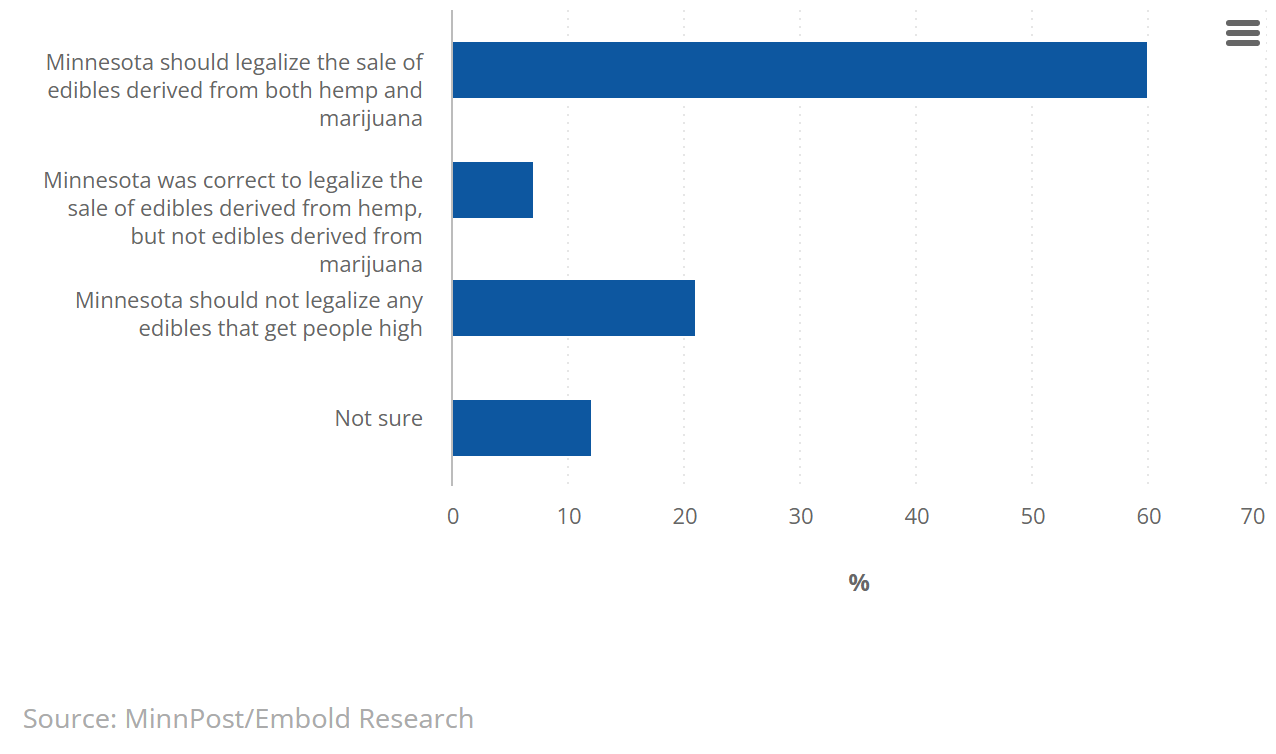
A majority of Minnesotans surveyed as part of a new MinnPost/Embold Research poll say they support the state legalizing intoxicating THC edibles and beverages derived from hemp — which happened in July — and said the state should legalize marijuana-derived edibles.

In 2012, Colorado and Washington became the first states to legalize recreational marijuana use. Since then, 19 states and the District of Columbia have made marijuana legal for recreational use, according to the National Conference of State Legislatures.

In Minnesota, medical marijuana has been legal since 2014, but efforts to make the substance legal for recreational use have failed to gain traction. But this year, a controversial piece of legislation made edibles derived from hemp — not marijuana — legal in the state for adult recreational use.

The law, which went into effect July 1, allows for the purchase of food and beverages with up to 5 milligrams of THC per serving while placing a limit of 50 milligrams per package. It came as a surprise to many after its passage, with some elected officials admitting they weren’t aware of the scope of the bill when it passed. The law doesn’t include provisions for regulation, taxation or enforcement, prompting some local governments around the state to develop their own enforcement rules.

Still, the poll suggests the regulatory change making THC edibles and beverages legal in Minnesota is popular with Minnesotans: 60% of the poll’s respondents said they believe Minnesota should allow the sale of THC edibles and beverages made from both hemp and marijuana. Another 7% of those polled say the new law allowing hemp-derived products works for them but don’t support the legalization of products made from marijuana. Crosstabs can be found here.


Continue reading

Recreational marijuana is the future

It’s time Iowa joins the winning team and legalizes marijuana.

Individuals with a federal charge for marijuana possession are no longer criminals.

President Joe Biden declared a pardon on Oct. 6 for thousands of individuals with a “simple marijuana possession.” Any other crimes that relate to marijuana are excluded.

Iowa should follow this example of clemency by decriminalizing recreational marijuana. Decriminalizing marijuana will create more equitable communities and give the state a stream of revenue.

Iowa is one of 31 states that criminalizes recreational marijuana use.

“As I said when I ran for president, no one should be in jail for using or possessing marijuana,” Biden said in a statement. “It’s already legal in many states, and criminal records for marijuana possession have led to needless barriers to employment, to housing, and educational opportunities. That’s before you address the racial disparities around who suffers the consequences.”

e-mail icon
Continue reading

Thousands more pets are getting sick from accidentally eating Marijuana

The ASPCA Animal Poison Control Center reports that it handled more than 6,200 cases of potential marijuana toxicity in 2021.

A few days ago, I arrived home to find my beloved 12-year-old dog in a semi-comatose state. She couldn’t move her back legs. She flinched when I touched her elsewhere. She was “out of it” in a way that almost suggested she might be experiencing a very bad trip.

As it turns out, that’s exactly what was happening. The 16-pound Lulu was suffering from marijuana toxicity, as I learned after rushing her to an emergency vet.

At first, I was confused: My wife and I don’t keep marijuana in the house. But we do take Lulu out for two walks a day in our New York City neighborhood. The vet suspected Lulu probably found the marijuana, whether in plant or edible form, somewhere along our morning stroll and then ingested it, with the drug taking full effect hours later.

The vet added that this is becoming almost an everyday occurrence in her practice: Dogs like to eat whatever they come upon in the streets — or in the home — and the consequences can sometimes be medically serious.

I always knew that chocolate was hazardous for dogs. Same with rat poison, which can also be found on city streets. But marijuana? And was this really occurring on a regular basis?

e-mail icon
Continue reading

Biden pardons thousands: is it enough?

On Oct. 6, President Joe Biden announced new efforts his administration is taking to reform the drug policy.

This includes taking steps to decriminalize marijuana, beginning with pardoning all people who have been convicted of marijuana possession under federal law. This does not include people who have been convicted of selling or distributing marijuana illegally. 

Biden also asked for the Secretary of Health and Human Services, Xavier Baccara, and Attorney General Merrick Garland to review the federal status of marijuana, according to Politico. Marijuana is currently classified as a Schedule I Drug under the Controlled Substances Act, meaning that it has no acceptable medical purposes and is highly addictive.

This categorizes marijuana with drugs such as heroin, LSD and ecstasy, and it prohibits all marijuana use according to the Drug Enforcement Administration. Lowering marijuana’s classification to a Schedule II Drug would put it in the same category as most opioids, and it would allow marijuana to be prescribed by doctors, according to Reuters. 

Criticisms of the efforts have come from both sides of the aisle. Some Democrats and progressives see the efforts as a step forward, but not eliminating major problems, considering the pardons impact relatively few people. According to Reuters, there are not many federal convictions for simple marijuana possession, and the administration says the pardons will affect 6,500 people. As a result, many activists say that this does not address the heart of the problem.

Although this will not result in people leaving prison, it will clear the records of those affected, allowing them to gain employment opportunities, apply to colleges and obtain other opportunities to help them move forward with their lives. Biden also acknowledged that many people are convicted under state or local laws, according to Reuters. He encouraged governors to pardon people convicted of simple marijuana possession under state laws.

e-mail icon
Continue reading

Government of Yukon completes handover of cannabis retail sales to private sector

The Yukon’s cannabis licensees now operate all retail locations, online sales and delivery.

As of 17/10/2022, the Yukon Liquor Corporation’s Cannabis Yukon website will no longer sell cannabis products to Yukoners, leaving cannabis e-commerce to private licensees.

In May 2022, the Government of Yukon introduced regulations that allow licensed cannabis retailers in the Yukon to sell and deliver legal cannabis products to Yukoners. This fulfilled the Government of Yukon’s commitment to support the Yukon’s private cannabis industry.

I am pleased to fulfill our commitment to transfer all cannabis retail, including online sales, to the Yukon’s private, licensed retailers. The Yukon’s cannabis industry continues to see year-over-year growth and I look forward to seeing the  industry continue to thrive, responsibly serve Yukoners and contribute to our territory’s economy.

Minister responsible for the Yukon Liquor Corporation Ranj Pillai

Quick facts 

Cannabis Yukon opened in October 2018 and closes today. The website is being re-purposed to provide wholesale purchasing options to the Yukon’s licensed retailers.

e-mail icon
Continue reading

Cannabis lands a Homerun: major league baseball signs deal with CBD Company

In a recent announcement, Major League Baseball announced a sponsorship deal with cannabidiol (CBD) company Charlotte’s Web.

Major League Baseball (MLB) is continuing to be a breakout star in the cannabis industry. In 2019, they removed cannabidiol (CBD) from its list of banned drugs (1), which was the first US sports league to do so. Now, the MLB is the frontrunner again by striking a sponsorship deal with cannabidiol (CBD) products maker Charlotte’s Web, the first of the four major US sports leagues to reach a deal with a CBD company (2).

CBD is a cannabinoid known for its medicinal uses to relieve pain and alleviate stress. Charlotte’s Web Holdings Inc. produces a variety of CBD products such as tinctures, topical sprays, and gummies. The MLB’s press release (3) stated, “The rigorous approval process that brought the two legacy brands together fills a major gap in the sports channel for an NSF Certified for Sport® portfolio of CBD products for players and consumers demanding safe, natural options to support recovery, help keep calm under pressure, and help sleep cycles and focus.”

In June, the US Sport league officially allowed clubs to form sponsorships with CBD companies that are certified for sport by The National Science Foundation (NSF), which is an institution that inaugurates standards for products used by athletes. Numerous celebrities and athletes have endorsed CBD products. For example, Hall of Fame National Football League (NFL) running back, Terrell Davis, partnered with investors in 2018 to produce a CBD-infused sports drink (2).

The newly formed partnership between the MLB and Charlotte’s Web arrives as the CBD maker releases a product called Daily Edge, a tincture that is also the first CBD product to be certified for sports by NSF. The item will feature the MLB logo on its bottle. The US Food and Drug Administration (FDA) has yet to certify CBD products, but that hasn’t stopped the cannabinoid from growing in popularity. As reported in 2021 (2), the US CBD market hit $4.7 billion in total sales. The MLB and Charlotte’s Web three-year deal is worth $30.5 million (1). One of the deal’s components will be to promote Charlotte’s Web products during games, as well as on the MLB’s social media platforms, streaming digital channels, and during post-season games. The leagues fanbase is estimated around 180 million fans, which will bring a different geographic of customers to Charlotte’s Web.

"Wherever you see MLB, you'll see Charlotte's Web," Jacques Tortoroli, CEO of Charlotte's Web, told CBS on their MoneyWatch program (1). "What we're about is making sure there's calmness of the mind so you can perform your best."

Also included in their partnership, the MLB obtained an estimation of 6.1 shares of Charlotte’s Web (1). The CBD company also is required to pay the MLB a 10% royalty on any products sold that have the MLB branding on it after the total sales exceed $18 million. Shortly after the MLB’s announcement, Charlotte Web’s stock rose nearly 25% and traded at 75 cents a share.

e-mail icon
Continue reading

Most Americans support forgiveness for Past Marijuana crimes, oppose Cannabis’ schedule

Most Americans oppose marijuana’s categorization as a Schedule I controlled substance under federal law, and they support efforts to forgive those convicted of cannabis-related offenses, according to nationwide survey data compiled by USA Today/Ipsos Polling.

Nearly three in four Americans — including majorities of Democrats, Independents, and Republicans — support “changing how federal law classifies marijuana.” Since 1970, the US Controlled Substances Act has categorized marijuana in the same classification as heroin — defining it as a substance with a “high potential for abuse, … a lack of accepted safety, … and no currently accepted medical use in treatment in the United States.”

NORML has long called for the removal of cannabis from the CSA (a/k/a descheduling) in a manner similar to alcohol as opposed to moving it to a lower schedule like cocaine (Schedule II) or anabolic steroids (Schedule III). “In order to rectify the state/federal conflict that currently exists over marijuana policy, and in order to best maintain the market controls that a majority of states have enacted to promote public health, prevent the distribution of marijuana to minors, ensure safe business practices, and improve public safety, cannabis must be descheduled — not rescheduled — from the Controlled Substances Act,” NORML acknowledges in a position statement.

Public support for either pardoning or releasing those convicted for low-level marijuana-related crimes at either the state or federal level is more partisan with super-majorities of Democrats and Independents supporting such efforts, but only a minority of Republicans.

On Thursday, President Biden announced forgiveness for an estimated 6,500 people with marijuana-related federal convictions on their record. He also called upon Governors to take similar steps. According to archived data from the FBI, an estimated 29 million Americans have been arrested for violating state or local marijuana laws since the mid-1960s.

NORML’s Deputy Director Paul Armentano praised the President’s actions in a new op-ed, opining, “Biden’s foray into the arena of marijuana reform legitimizes legalization as a subject worthy of consideration — and action — by those at the highest levels of government. Further, it is a recognition — by the president of the United States, no less — that America’s nearly 100-year experiment with cannabis criminalization has been an abject failure.”

e-mail icon
Continue reading

University research into Marijuana urged with safety issues

State Assembly member Crystal Peoples-Stokes told 2 On Your Side, "There's no question we don't know how to determine if somebody is impaired by it or not..."

BUFFALO, New York — As state efforts continue to get licensed marijuana sales up and running here in New York there is also a call again for more research into the usage of pot and its effects on those who use it.  

That could include anyone who uses marijuana and may be impaired while driving.

With the legalization of marijuana and the state's efforts to set up dispensaries to sell it, the Western New York politician who orchestrated the push to get it done says she has a real concern about those who might use it and then operate a motor vehicle. 

State Assemblymember Crystal Peoples-Stokes told 2 On Your Side, "There's no question we don't know how to determine if somebody is impaired by it or not. Which we should know that."   

In fact, the Insurance Institute for Highway Safety this past summer said a survey of five states which previously legalized marijuana saw a nearly 6 percent increase in traffic crash injuries. They also recorded just over a four percent rise in fatal crashes after pot sales began. That is in contrast with no increase for six other states where it is still illegal. 


Continue reading

Cannabis-derived gummy worms found in 5-year-old’s Halloween candy, mom says

ST. LOUIS - A mother in Missouri says she found cannabis-derived gummy worms in her 5-year-old’s Halloween candy after a trunk-or-treat event Saturday.

Tiffany Burroughs took her three young boys to the event held at JJ’s Restaurant, which hosts monthly car shows.

Restaurant co-owner Stephen Bell said the Halloween-themed event held in October, in conjunction with trunk-or-treat, always has a big turnout.

“They loved going, dressing up in their costumes,” Burroughs said.

Burroughs said she noticed an unusual package of gummy worms in a candy bowl but didn’t think much about it until she inspected the children’s candy at home.

The package was labeled as “Delta 8,” which is a cannabinoid found in the Sativa plant.

e-mail icon
Continue reading

WeedLife.com